Volume 2
Reports of the Sleeping Sickness Commission of the Royal Society.
- Royal Society (Great Britain). Sleeping Sickness Commission
- Date:
- 1903-19
Licence: Attribution-NonCommercial 4.0 International (CC BY-NC 4.0)
Credit: Reports of the Sleeping Sickness Commission of the Royal Society. Source: Wellcome Collection.
Provider: This material has been provided by Royal College of Physicians, London. The original may be consulted at Royal College of Physicians, London.
20/84 page 12
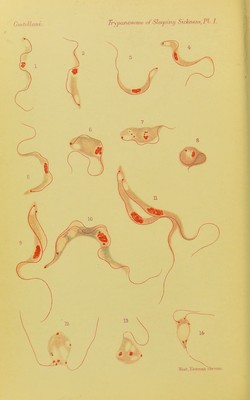
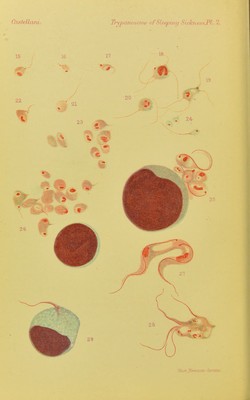
![times, very fine flagella. Sometimes there is only one large vacuole, in other instances there may Ije several vacuola. Similar l^odies have been described by Eabinovitsh and Kempner in Trypanosoma Lewisi. Eabinovitsh and Kempner have drawn them without flagella, but they admit now* that possibly some very fine flagella may be present. The interpretation of these bodies is very difficult; they might be degenerative forms, but I am more inclined to consider them developmental forms of the parasite. Doflein thinks that the, Eabinovitsh-Kempner bodies observed in Try p. Lewisi represent perhaps stages of a sexual reproduction. Group 2. Amoeboid forms, (Figs. 15:—19.)—These forms were first described by Plimmer and Bradford in Tryp. Brucei. They are very small, tbeir diameter being 5 to 7 /x; the shape is variable. The typical ones are more or less pear-shaped. At the acute extremity there is very frequently a fine short flagellum. A macro-nucleus and a micro-nucleus are present; sometimes they may be divided. Eound the macro- and micro-nucleus there is an unstained portion like a vacuolum. The flagelhira takes origin apparen fcly from the micro-m;cleus. The amoeboid forms I have seen only in the cerebro-spinal fluid. Sometimes one observes a large number of these amoeboid forms agglomerate together something like a plasmodium formation. (Fig. 22.) I do not intend to go into the question as to what these bodies really represent; it is well known bow far the opinions of Plimmer and Bradford, and Laveran and Mesnil diff'er on the amoeboid forms of Tryp. Brucei, but I think it is interesting to note that identical bodies are seen also in the trypanosome of Sleeping Sickness. Investigation of Tissues fo7- Trypanosoraes. In animals infected with Nagana or Surra the parasites may lie found in some organs, spleen, &c. Very interesting are the experi- ments of Plimmer and Bradford, who observed the cai^illarics of brain of animals infected with Nagana full of amoeboid forms. ]Mr. Plimmer has very kindly examined pieces of brain and spleen from Sleeping Sickness patients. So far he has not been able to find any parasites. I hear also that Professor Mott has not yet found parasites in the tissues he has received from Uganda. I have also examined several pieces of tissues of brain and .spleen, hardened in alcohol emljcdded in paraffin and stained with Leishman's method, but so far I have found nothing. Still, too much importance must not be attached to these negative results, as this investigation has been carried out on sections of the tissues. Smears of the tissues might give much better results. From my researches it would seem that in the trypanosome of * Oral (.•oiiiimiuicntion.](https://iiif.wellcomecollection.org/image/b24750530_0002_0020.jp2/full/800%2C/0/default.jpg)