Volume 2
Reports of the Sleeping Sickness Commission of the Royal Society.
- Royal Society (Great Britain). Sleeping Sickness Commission
- Date:
- 1903-19
Licence: Attribution-NonCommercial 4.0 International (CC BY-NC 4.0)
Credit: Reports of the Sleeping Sickness Commission of the Royal Society. Source: Wellcome Collection.
Provider: This material has been provided by Royal College of Physicians, London. The original may be consulted at Royal College of Physicians, London.
9/84 page 7
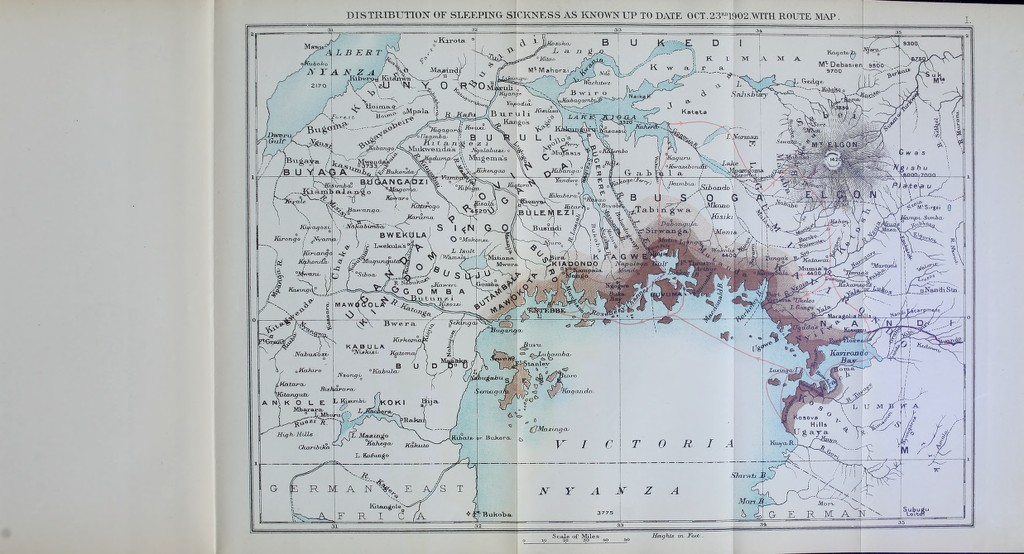
![This fact must be something more than a coincidence. Wherever the banana is growing, in the districts I have examined, there is found the F. ]M;rsfans. What is more, it would seem tliat where the banana is most luxuriant (on Mount Elgon) there the inhabitants are most infected (60 to 70 per cent, and the blood crowded). The converse of this is also clearlj' correct, as will be seen by the map, viz., where the banana is scarce (in Southern Bukedi, and Northern Kavirondo, in which latter place it is only grown inside the mud walls of the small villages) there the percentage of F. joerstans is small; and where there is no banana there is no F. perstans. The banana, I am told, is grown all over Uganda and the Western Provinces (Ankol6, Toro, and Unyoro), its limit to the north being the Victoria Nile. It remains for me to prove, if this is so, whether the Nile is here also the limit of F. perstanfi. From slides I have obtained from these districts this would seem to be the' case. The banana when full}' grown is peeled and boiled or steamed in an earthenware pot. The leaves are used for plates and dishes, for thatching houses, for clothing, for mattresses to sleep upon, for pipe stems and many other things. The skins of the fruit are used for making soap, and the stems for rope, etc. There is yet another area which coincides in almost as remarkable a manner with that of F. perstans as does the area of cultivation of the banana. This is the area in which live people who wear clothes. To the north and east of the red pencil line on the banana map are the Nilotic races to the north of the Victoria Nile, the Bukedi (the word meaning the land of naked people), the Bagesu on Mount Elgon (some of whom, however, as I saw them wore small pieces of bark-cloth and skins), and the Kavirondo, who, like the Bukedi, are, both men and women, entirely naked, not even using a loin-cloth. When coming into Kisumu market a small goat-skin, in the case of the men, is occasionally worn over the buttocks, but nothing in front, while some of the women wear a few red and white beads in front and a tassel of string or grass behind. The line of demarcation between the clothed and unclothed is everywhere distinct, but as civilisation advances this line will gradually fade with increasing rapidity, as it is now said to be doing. The Victoria Nile therefore has a treble interest attached to it, for it remains to be discovered whether it is the limit of the areas of F. perstans, of the banana, and of the clothed people, in a similar manner to that already shown to be the case to the eastward, and mapped out in the attached maps. The word clothing has not, of course, the significance that it has in Europe. It here means merelj'- a loose gown of white Americana, a toga of brown or black native bark cloth (hammered out from the bark of a tree), a specimen of which is enclosed, or a small piece of bark-cloth suspended from the hips. Working in the fields the cloth, in most cases, is discarded. AVith regard to mosquitoes, I have made a careful collection all](https://iiif.wellcomecollection.org/image/b24750530_0002_0009.jp2/full/800%2C/0/default.jpg)