Sketch of the medical history of the native army of Bombay, for the year 1876. : The regiments are placed as they stood in the army list of the 1st July 1876].
- Bombay (Presidency). Military Department.
- Date:
- 1877
Licence: Public Domain Mark
Credit: Sketch of the medical history of the native army of Bombay, for the year 1876. : The regiments are placed as they stood in the army list of the 1st July 1876]. Source: Wellcome Collection.
Provider: This material has been provided by London School of Hygiene & Tropical Medicine Library & Archives Service. The original may be consulted at London School of Hygiene & Tropical Medicine Library & Archives Service.
21/170 (page 5)
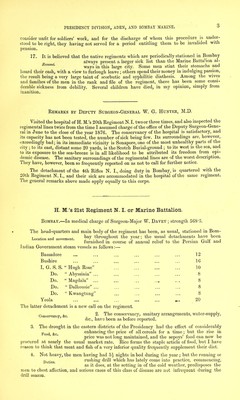
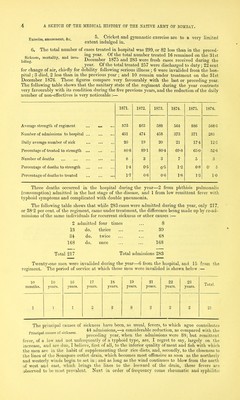
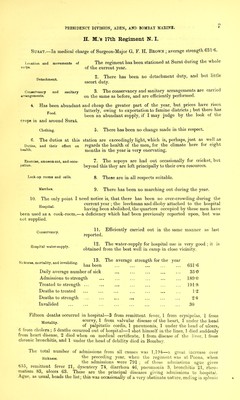
![affections, 13 of the former and 29 of the latter. I regret to say syphilis of a very bad type is exceedingly prevalent in Bombay, and the' men of the regiment of loose morals, who resort to the town, have suffered very severely; not only have the primary attacks been of the sloughing variety of the disease, but nearly all the cases have been affected in quick succession with secondary and tertiary forms of the disease. I believe I am not the only medical officer at the Presidency who thinks this disease ought not to be allowed to reign rampant in Bombay, without any attempt to check its ravages. Eruptive fevers give only 2 admissions for chicken-pox as last year, both mild cases, and calling for no remark ; scurvy gives 4 admissions, and these not furnished fey the detachments serving in the Persian Gulf or on board the Indian Government vessels, but contracted on shore from low living. This form of scurvy is much more intractable than that contracted on boardship ; the men suffer for months before any signs of impaired health become visible, and it is only when they fear to be invalided that those not entitled to pension allow themselves a more sustaining diet, and then begin to improve in health. Local disease contribu tes 136 admissions, of which the skin, which includes that most fre- quent disease amongst natives—scabies—gives as many as 4*5 admissions; but diseases of the more important organs, such as the eye and lungs, have not been infrequent ; 14 of the former and 17 of the latter have been treated. And whilst diseases of the eye have readity yielded to treatment, lung diseases, preceded as it often is with remittent fever of a low type, has been found much more difficult to combat, requiring a free administration of stimulants and nourishment. Diseases of another very important organ—the liver—have not been absent, and diseases of the bowels, including diarrhoea and dysentery, have furnished their usual quota. The remainder of this class of diseases call for no remark, unless I except gonor- rhoea, to which, however, the men are less exposed than to the more constitutionally destructive disease, syphilis; but amongst ulcers, although small in number, one case of sepigenous ulcer, affecting the back of the elbow, is deserving of notice. The man had recently returned from the Persian Gulf; and I am informed that the disease is not uncommon there, and is ascribed to eating dates. Whatever its origin may be, it is exceedingly intractable, and recurs again and again. As soon as one small spot of ulceration is healed, a small fresh corrosion of the skin takes place, until the ulcer presents a very good specimen of skin-grafting; this ulceration or corrosion in the case, which has more than once come under my observation, is superficial in its character, but affects the true skin, but does not touch the deeper structures. It became necessary to invalid the case in question. 8. One from remittent fever, complicated with double pneumonia, and 2 from Principal causes of mortality. phthisis pulmonalis, both cases admitted in the third stage of the disease. 9. Two Mussulmans, or 1'3 per cent, to strength, and one Hindu, or 0-2 per cent, to strength. Mortality according to race. 10. Small-pox occurred amongst the families of the regiment; but the cases were early „ . isolated, and no sepoy was affected. There were 9 cases in all, with the result of 1 death ana o recoveries.; the first case occurred in January, and the last in April. 11. Vaccination and re-vaccination. One hundred and eighteen children were primarily vaccinated—112 successful, and 6 failed ; 50 persons re-vaccinated, of which number 19 only were successful. At the commencement of the outbreak of small- pox in the native town in the earlier part of the year, all the women and children were mustered for examination, and 87 doubtful subjects were selected for vaccination or re-vaccina- tion, of which number 68 were successful. 12. The general health of the men has been unusually good, only 52'6 per cent, to strength having come under treatment during the year. Con- sidering the class from which the regiment is recruited, the physique of the men is fair; but they cannot compare in height, muscular development, with the sepoys recruited in the North-West General health and physique of the men. breadth of Provinces. 13. chest, or The most noticeable feature in the return is the great reduction which has been Resumi of the whole eff ected in the daily average number of sick men. In 1875 these amounted to 17'4, and the average for the previous 5 years amounts to 19’4, while for the year under report the number of daily non-effectives is only ]2-5. If it were possible to substitute a more nourishing diet for the sepoys, the men would not be so liable to such low forms of fever complicated with lung and hepatic disease, as they now suffer from, more especially during the warmer months of the year, when the winds are more or less northerly, and the Sonapore drain becomes more than usually offensive, and without doubt assists a spare diet in the production of disease,](https://iiif.wellcomecollection.org/image/b2491549x_0021.jp2/full/800%2C/0/default.jpg)