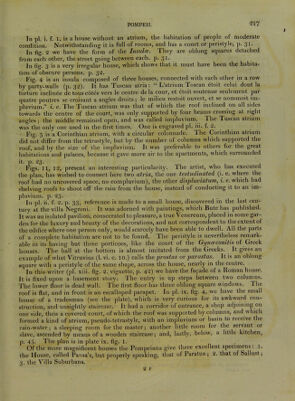
Foreign topography; or, an encyclopedick account, alphabetically arranged, of the ancient remains in Africa, Asia, and Europe; forming a sequel to the Encyclopedia of antiquities / By the Rev. Thomas Dudley Fosbroke.
- Thomas Dudley Fosbroke
- Date:
- 1828
Licence: Public Domain Mark
Credit: Foreign topography; or, an encyclopedick account, alphabetically arranged, of the ancient remains in Africa, Asia, and Europe; forming a sequel to the Encyclopedia of antiquities / By the Rev. Thomas Dudley Fosbroke. Source: Wellcome Collection.
320/470 page 218
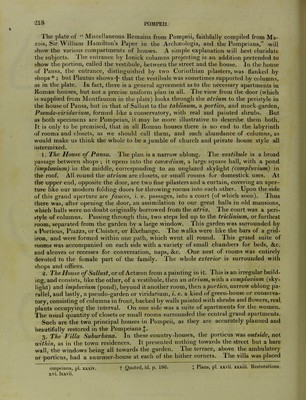
![The plate of “ Miscellaneous Remains from Pompeii, faithfully compiled from Ma- zois, Sir William Hamilton’s Paper in the Archaeologia, and the Pompeiana,” will show the various comj)artments of houses. A simple explanation will best elucidate the subjects. The entrance by lonick columns projecting is an addition pretended to show the portion, called the vestibule, between the street and the house. In the house of Pansa, the entrance, distinguished by two Corinthian pilasters, was flanked by shops* ; but Plautus shows'^ that the vestibule was sometimes supported by columns, as in the plate. In fact, there is a general agreement as to the necessary apartments in Homan houses, but not a precise uniform plan in all. The view from the door (which is supplied from Montfaucon in the plate) looks through the atrium to the peristyle in the house of Pansa, but in that of Sallust to the tahlinum, a portico, and mock-garden, Pseiido-viridarium, formed like a conservatory, with real and painted shrubs. But as both specimens are Pompeian, it may be more illustrative to describe them both. It is only to be premised, that in all Roman houses there is no end to the labyrinth of rooms and closets, as we should call them, and such abundance of columns, as would make us think the whole to be a jumble of church and private house style all intermixed. 1. The House of Pansa. The plan is a narrow oblong. The vestibule is a broad passage between shops ; it opens into the cavcedium, a large square hall, with a pond (impluvium) in the middle, corresponding to an unglazed skylight (compluvium) in the roof. All round the atrium are closets, or small rooms for domestick uses. At the upper end, opposite the door, are two fine pilasters and a curtain, covering an aper- ture like our modern folding doors for throwing rooms into each other. Upon the side of this grand aperture are fauces, i. e. passages, into a court (of which soon). Thus there was, after opening the door, an assimilation to our great halls in old mansions, which halls were no doubt originally borrowed from the atria. The court was a peri- style of columns. Passing through this, two steps led up to the triclinium, or furthest room, separated from the garden by a large window. This garden was surrounded by a Porticus, Piazza, or Cloister, or Exchange. The walks were like the bars of a grid- iron, and were formed within one ])ath, which w'ent all round. This grand suite of rooms was accompanied on each side with a variety of small chambers for beds, &c. and alcoves or recesses for conversation, naps, &c. One nest of rooms was entirely devoted to the female part of the family. The whole exterior is surrounded with shops and offices. 2. The House of Sallust, or of Actaeon from a painting in it. This is an irregular build- ing, and consists, like the other, of a vestibule, then an atrium, with a compluvium (sky- light) and impluvium (pond), beyond it another room, then portico, narrow oblong pa- rallel, and lastly, a pseudo-garden or viridarium, i. e. a kind of green-house or conserva- tory, consisting of columns in front, backed by walls painted with shrubs and flowers, real plants occupying the interval. On one side was a suite of apartments for the women. The usual quantity of closets or small rooms surrounded the central grand apartments. Such are the two principal houses in Pompeii, as they are accurately planned and beautifully restored in the Pompeiana;}:. 3. The Villa Suhurband. In these country-houses, the porticus was ow^A'irfe, not within, as in the town residences. It presented nothing towards the street but a bare wall, the windows being all towards the garden. The terrace, above the ambulatory or porticus, had a summer-house at each of the hither corners. The villa was placed ompeiana, pi, xxxiv. xvi. Ixxvii. t (Quoted, id. p. 186. X Plans, pi. xxvii. xxxiii. Restorations,](https://iiif.wellcomecollection.org/image/b22012035_0320.jp2/full/800%2C/0/default.jpg)