Foreign topography; or, an encyclopedick account, alphabetically arranged, of the ancient remains in Africa, Asia, and Europe; forming a sequel to the Encyclopedia of antiquities / By the Rev. Thomas Dudley Fosbroke.
- Thomas Dudley Fosbroke
- Date:
- 1828
Licence: Public Domain Mark
Credit: Foreign topography; or, an encyclopedick account, alphabetically arranged, of the ancient remains in Africa, Asia, and Europe; forming a sequel to the Encyclopedia of antiquities / By the Rev. Thomas Dudley Fosbroke. Source: Wellcome Collection.
331/470 page 227
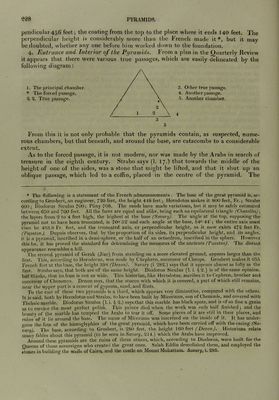
![been superseded by the spirited labours of modern travellers, especially the one named, and therefore his account shall be first given. 1. The Stones of the Pyramids were taken from the spot. Belzoni observed the rock surrounding them, on the north and west sides, to be on a level with the upper part of the chamber, and as the rock is evidently cut all round the pyramid, the stones taken from that rock must have been applied to the erection of the fabrick, and blocks of an enormous size have been cut out. If any traveller, he says, will go within less than half a mile of the pyramids, particularly on the east and south sides, he may see many places where the rock has been formerly quarried to a great length, and he will find that there is stone enough to build many other pyramids, if required. It is true that Herodotus says the stones to erect the pyramids were brought from quarries on the other side of the Nile; but Belzoni firmly believes, that he (Herodotus) was mis-in- formed, unless he alluded to the granite alone. As to the causeways in front of the pyramids, said to have been made to convey the stones for the erection of these masses, he thinks that they w’ere intended for the accommodation of visitors, particu- larly at the time of high Nile, and if they were only to convey stones, the labour of making them must have been nearly equal to the erection of the pyramids. Belzoni, 275. 2. Pyramids Sepulchres. The circumstance of having chambers and a sarcopha- gus, which undoubtedly contained the remains of some great personage, so uniform with those in the other pyramid, leaves,Belzoni thinks, very little doubt, but that they were erected for sepulchres, and he wonders that any doubt has ever existed, consider- ing what could be learned from the first pyramid, which has been so long open. This contains a spacious chamber with a sarcophagus ; the passages are of such dimensions as to admit nothing larger than the sarcophagus. They had been closely shut up by large blocks of granite from within, evidently to prevent the removal of this relick. Ancient authors have pretty well agreed in asserting that these monuments w'ere erected to contain the remains of two brothers Cheops and Cephren, Kings of Egypt. They are surrounded by other smaller pyramids, intermixed with mausolea, or burial grounds. Many mummy-pits have been found. Belzoni, 22^. 3. Admeasurement, 8^c. of the Pyramids. Mr. Davison’s admeasurement of the great pyramid of Gihez is of the square 746 feet *. The perpendicular height 4fi0 feet 11 inches. It consists of stories regularly disposed. Two hundred and six tiers compose the whole height. As the square of every tier is less than the one below it, the space of two or three feet, which is left on all sides by each of them, as they di- minish towards the top, forms what is generally called the steps. They are of differ- ent dimensions. The entrance [the forced owe] is upon the l6th step facing the north. It is not in the middle as is generally imagined, but only 350 feet distant from the north-east coiner, whereas it is 396 feet from the north-west corner. Ac- cording to the French admeasurement, the base of the three pyramids; of Cheops (the largest); Cephren (the second) ; and Mycerinus (the smallest), is, to their per- pendicular height nearly in the ratio of 8 to 5. Cheops 448 feet high, 728 length of base; Cephren 39S high, 655 length of base; Mycerinus 162 high, 280 length of base, (Ip'alpole, i. 347—349.) According to Belzoni (278) the base is 684 feet, the apotome or central line down the front from the top to the base 5^8 feet, the per- * Lincoln’s-inn-fields in London, is said to be the size of the base,](https://iiif.wellcomecollection.org/image/b22012035_0331.jp2/full/800%2C/0/default.jpg)