Foreign topography; or, an encyclopedick account, alphabetically arranged, of the ancient remains in Africa, Asia, and Europe; forming a sequel to the Encyclopedia of antiquities / By the Rev. Thomas Dudley Fosbroke.
- Thomas Dudley Fosbroke
- Date:
- 1828
Licence: Public Domain Mark
Credit: Foreign topography; or, an encyclopedick account, alphabetically arranged, of the ancient remains in Africa, Asia, and Europe; forming a sequel to the Encyclopedia of antiquities / By the Rev. Thomas Dudley Fosbroke. Source: Wellcome Collection.
386/470 page 276
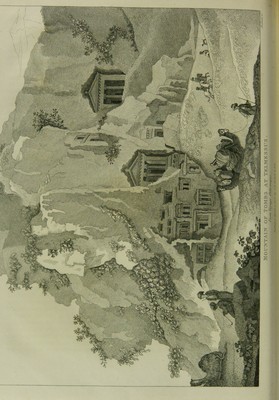
![only the mountains but the sea itself, and all the prosj)ect before the spectators who were assembled in these buildings, must have been considered by the architects of Grecian theatres, as forming parts of one magnificent design. Savary, who saw this theatre at Tel- messus, says, it is much less than that at Patara, and we found its diameter not half so great as that of AlexandriaTroas, yet the effect produced by it seems to be greater. Some of the stones used in its construction are g feet long, 3 feet wide, and 2 feet thick. Three immense portals, resembling the trilithons of Stonehenge, conducted to the arena. The stones which compose these gates are yet larger than those already mentioned. The central gateway consists only of five, and the two others of three each placed in the most simple style of architecture. Every thing at I’ehnessus is Cyclopean. A certain vastness of proportion may be said to characterise the Vestiges of the Dorian colonies, over all the coast of Asia Minor. The enormous masses be- longing to the doors of the Telmessensian theatre were placed together without any cementation or grooving. They were simply laid one upon the other, and some notion may be formed of the astonishing labour necessary in the completion of the edifice to which they belonged, when it is further stated, that every stone in the outer walls of the building was adorned by a relief formed in bevelling the edge. There were originally five immense portals leading to the arena, although three only remain standing at this day. The largest of these, being the central place of entrance, con- sisted of five pieces of stone, two being on either side as uprights, and one laid across [like the Stonehenge trilithons]. The uprights are ten feet two inches, and five feet eleven inches thick; the whole height of this door, 16 feet and l inch. The breadth of these stones is 3 feet 10 inches, and they are 20 inches thick. The space for the entrance is 7 feet 3 inches wide, and the length of the upper stone placed across the uprights is 10 feet 7 inches, all of one entire mass. The doors on each side of the main entrance, consisting only of three stones each, had for their uprights masses of 11 feet 3 inches in height, 4 feet in breadth, 19 inches in thickness, and the space for the entrance 6 feet 4 inches. Those upon the right and left of the three in the centre were still smaller. The form of this theatre is semicircular. It has 28 rows of seats, and all of them remain entire. The rows are divided into two parts by a corridor, passing all round, fourteen seats being in the upper division, and the same number in the lower. In the upper compartment on this side of the theatre is a vaulted chamber, one being exactly opposite to the other. Perhaps the measure across the arena to the beginning of the seats may rather prove its form to be elliptical tlian semicircular. We found the dis- tance from the centre parts to the lower bench to be 35 yards, and we obtained a major diameter of 37 yards by measuring the distance from side to side. The stones of which the walls consist, between the portals, are 8 feet 10 inehes in length. These were placed together without cement, and exhibited the same massive structure. The height of the seats was 16 inches, the breadth 25. The height of the corridor passing round the back of the lower tier is 5 feet 6 inches; so that the elevation of the persons placed in the upper tier was 42 feet above the arena. Thus Dr. Clarke, iii. 291—296. In the Voyage Pittoresque (i. pi. 7I.) is a view of the theatre. The jambs and trili- tha are there composed of pieces. The perpendiculars and the arcliitrave are carved, unlike those of Dr. Clarke. In Plate 72, are details of the Theatre. To proceed with Dr. Clarke. Before the front of this fine Theatre extended a noble terrace, to which a magnificent flight of stej)s ascended from the sea. Th^](https://iiif.wellcomecollection.org/image/b22012035_0386.jp2/full/800%2C/0/default.jpg)