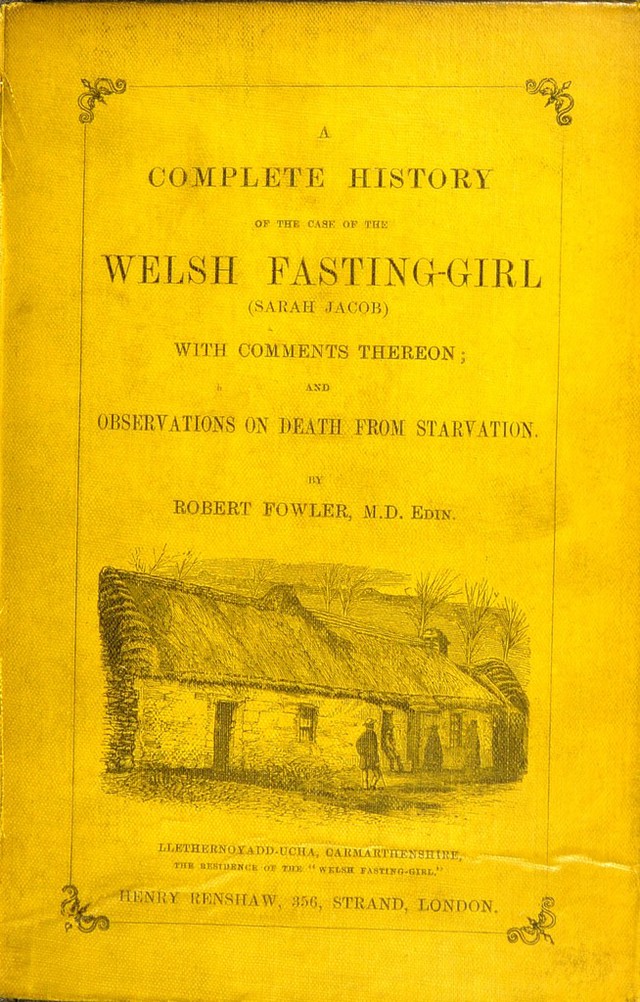
A complete history of the case of the Welsh fasting-girl (Sarah Jacob) with comments thereon; and observations on death from starvation.
- Fowler, Robert
- Date:
- 1871
Licence: Public Domain Mark
Credit: A complete history of the case of the Welsh fasting-girl (Sarah Jacob) with comments thereon; and observations on death from starvation. Source: Wellcome Collection.
Provider: This material has been provided by Royal College of Physicians, London. The original may be consulted at Royal College of Physicians, London.
279/326 page 267
![analogous to the bybernalion of the lower animals, or a state of pro- longed trance. _ We do not pretend to fix exactly, physiologically, the time during which a particular person could last, nor are we prepared to say what would be its exact limit under pathological circumstances ; but sixteen or seventeen months is named in this case ! The possi- bility of this, may not be a question for a weak immature thing like medical science to decide; but it has a bearing upon other and stronger branches of physical science—chemistry, for example. Growth and development have gone on, and the little patient has maintained her animal heat. How ? If one knew the weight of a candle, and the rate of its consumption in burning, it would be easy to say how long it would continue to burn. But what would the Vicar say if told that his neighbour's candle had been burning for sixteen months without any diminution of its tallow ? What a prize it would be to us, for St. Peter's ! He might not be able to give an explanation of his unbelief in the way that the late Mr. Faraday would have done; but, his own experience and that of his friends being all in favour of a candle burning by consumption of its tallow, he would discredit the statement. If he knew the nature and laws of combustion, he would feel perfectly sure of the matter. Now, although we do not know the exact functions of the spleen, as he triumphantly reminds us, we cer- tainly do know that combustion in and out of the body, is due to one and the same process, only Nature economizes her fuel far better than we do. The number of strange stories in the world is very large ; the trouble of investigating them is very great; and the mystery has so commonly faded away when thoroughly investigated, that we may be excused for not sending down a Commission to a village in Wales for the next sixteen months. Some fifty or sixty years ago, the Fasting- Girl at Tutbury was exciting just such a stir. The existence of a human being, performing the acts ascribed to this girl for that time without food, IS so contradictory of an immense body of facts of vanous kinds, that in order to establish its truthfulness we should require to set about our observations with all the rigour and exacti- tude employed in a scientific investigation, in order to exclude all possible sources of error, and there are a great many of these in the present instance. In one sense there is, of course, no such thing as an impossibihty. For all we know, stones might, in defiance of gra- vitation, take to flying upwards, and the first stone which did so would become a law unto itself. The course we proposed, was to remove the girl from the neighbourhood, send her to an infirmary, and plac'e her under the care, and at the disposal, of one of the me- dical stafi, who could take the means to render the experiment pretty certain We must apologize to our readei-s for dwelling upon such elementary details; but we wished to convince our worthy friend the Vicar that we could on occasion leave the Editorial, or —as he pleases to term it-the ' Papal' chair, and, instead of offering him dogmas, afford him reasons for our incredulity._rAe Lancet, May 1st, 1869, p. 624. > J > Human Natwre, vol. iii. J869, p. 205. fn, A - ^ luf]^ mundane transaction is to be found in the Welshman, April 30th, 1809 Western Mail, December 21st, 1869](https://iiif.wellcomecollection.org/image/b23982706_0279.jp2/full/800%2C/0/default.jpg)