Investigations into the growth of the lymphosarcomata in dogs / by John W. Hunter, Geo. M. Laws and Leo Loeb.
- Hunter, John W.
- Date:
- 1909
Licence: In copyright
Credit: Investigations into the growth of the lymphosarcomata in dogs / by John W. Hunter, Geo. M. Laws and Leo Loeb. Source: Wellcome Collection.
Provider: This material has been provided by The Royal College of Surgeons of England. The original may be consulted at The Royal College of Surgeons of England.
4/18 (page 2)
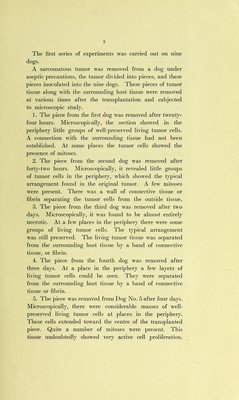
![bloodvessels grew into the tumor nodule from the neighboring tissue of the host. Bashford, Murray, and Cramer' disputed this fact, and stated that the formation of the growths resulted from an infection of the host, t)y an unknown microorganism. They believe tliat after transplantation a few tumor cells might remain alive for a few days, but that afterward the real, new tumor is produced through a proliferation of the fil)ro- blasts in the host, and their transformation into tumor cells. Beebe and Ewing^ on the other hand, showed that after transplantation the peripheral tumor cells remained alive and definitely gave origin to the new growth. They did not see any picture iiulicating transformation of the cells of the host into tumor cells. Notwithstanding the careful observations of these authors Wade,' the most recent investigator of this cpiestion, arrived at a did'erent conclusion. He believes that after trans- ])lantation the tumors have a double origin arising from the trans[)lanted tumor cells as well as through a transforma- tion of the fibroblasts of the host. He, therefore, calls the tumor an infective sarcoma. ddie problem of the origin of these tumors is a very im- portant one, inasmuch as its recognition as a tumor, in the restricted sense in which this term is usually employed at the pre.sent time, presupposes that the tumor takes its origin from the original tumor cells and not through an infection of the neighboring cells of the host. Whether such a conclusion is really justifiable we do not wish to discuss at the present time, but, however that may be, it is very necessary to determine which of the different views regarding the origin of the transplanted tumors is correct, especially as work on this tumor led to important discoveries, and as this tumor is still being used for further work. We therefore carried out several series of experi- ments with the aim of determining this cpiestion. ■ Scientific Report of the Cancer Re.search Fund, 1905, No. 2. ^ Jour. Med. Research., 1900, vol. xv. ^ Journ. Path, and Bact., vol. xii.](https://iiif.wellcomecollection.org/image/b2241888x_0006.jp2/full/800%2C/0/default.jpg)