Wellcome Collection homepage
  • Visit us
  • What’s on
  • Stories
  • Collections
  • Get involved
  • About us
Sign in to your library account
Search for anything
Library account
Take me back to the item page

Evolution.

  • Society for Experimental Biology
Date:
1953
Catalogue details

Licence: Attribution-NonCommercial-NoDerivatives 4.0 International (CC BY-NC-ND 4.0)

Credit: Evolution. Source: Wellcome Collection.

  • Front Cover
  • Title Page
  • Table of Contents
  • Back Cover
    25/484 (page 1)
    Previous page
    Next page
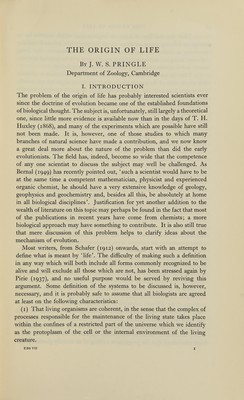
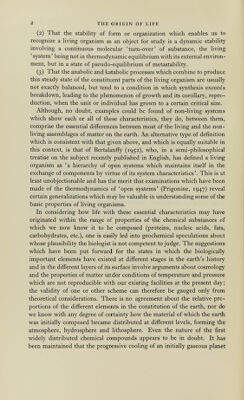
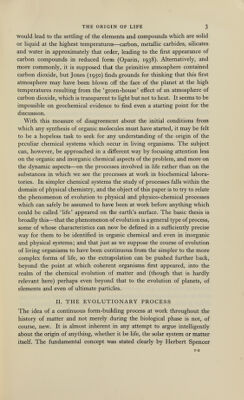
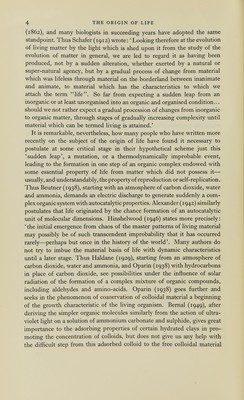
    THE ORIGIN OF LIFE By J. W. S.PRINGLE Department of Zoology, Cambridge 1. INTRODUCTION The problem of the origin of life has probably interested scientists ever since the doctrine of evolution became one of the established foundations of biological thought. The subject is, unfortunately, still largely a theoretical one, since little more evidence is available now than in the days of T. H. Huxley (1868), and many of the experiments which are possible have still not been made. It is, however, one of those studies to which many branches of natural science have made a contribution, and we now know a great deal more about the nature of the problem than did the early evolutionists. The field has, indeed, become so wide that the competence of any one scientist to discuss the subject may well be challenged. As Bernal (1949) has recently pointed out, 'such a scientist would have to be at the same time a competent mathematician, physicist and experienced organic chemist, he should have a very extensive knowledge of geology, geophysics and geochemistry and, besides all this, be absolutely at home in all biological disciplines'. Justification for yet another addition to the wealth of literature on this topic may perhaps be found in the fact that most of the publications in recent years have come from chemists; a more biological approach may have something to contribute. It is also still true that mere discussion of this problem helps to clarify ideas about the mechanism of evolution. Most writers, from Schäfer (1912) onwards, start with an attempt to define what is meant by 'life'. The difiiculty of making such a definition in any way which will both include all forms commonly recognized to be alive and will exclude all those which are not, has been stressed again by Pirie (1937), and no useful purpose would be served by reviving this argument. Some definition of the systems to be discussed is, however, necessary, and it is probably safe to assume that all biologists are agreed at least on the following characteristics: (i) That living organisms are coherent, in the sense that the complex of processes responsible for the maintenance of the living state takes place within the confines of a restricted part of the universe which we identify as the protoplasm of the cell or the internal environment of the living creature. EBS VII 1
    page 1
    25
    page 2
    26
    page 3
    27
    page 4
    28
    page 5
    29
    page 6
    30
    Previous page
    Next page

    Wellcome Collection

    183 Euston Road
    London NW1 2BE

    +44 (0)20 7611 2222
    info@wellcomecollection.org

    • Getting here

    Today’s opening times

    • Galleries
      10:00 – 18:00
    • Library
      10:00 – 18:00
    • Café
      10:00 – 18:00
    • Shop
      10:00 – 18:00

    Opening times

    Our building has:

    • Step free access
    • Hearing loops

    Accessibility

    • Visit us
    • What’s on
    • Stories
    • Collections
    • Get involved
    • About us
    • Contact us
    • Jobs
    • Media office
    • Developers
    • Privacy and terms
    • Cookie policy
    • Manage cookies
    • Modern slavery statement
    TikTok
    Facebook
    Instagram
    YouTube

    Except where otherwise noted, content on this site is licensed under a Creative Commons Attribution 4.0 International Licence