Wellcome Collection homepage
  • Visit us
  • What’s on
  • Stories
  • Collections
  • Get involved
  • About us
Sign in to your library account
Search for anything
Library account
Take me back to the item page

Evolution.

  • Society for Experimental Biology
Date:
1953
Catalogue details

Licence: Attribution-NonCommercial-NoDerivatives 4.0 International (CC BY-NC-ND 4.0)

Credit: Evolution. Source: Wellcome Collection.

  • Front Cover
  • Title Page
  • Table of Contents
  • Back Cover
    26/484 (page 2)
    Previous page
    Next page
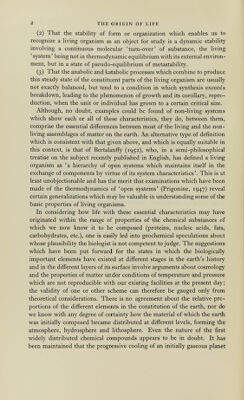
    2 THE ORIGIN OF LIFE (2) That the stability of form or organization which enables us to recognize a living organism as an object for study is a dynamic stability involving a continuous molecular 'tum-over' of substance, the living ' system ' being not in thermodynamic equilibrium with its external environ¬ ment, but in a state of pseudo-equilibrium of metastability. (3) That the anabolic and katabolic processes which combine to produce this steady state of the constituent parts of the living organism are usually not exactly balanced, but tend to a condition in which synthesis exceeds breakdown, leading to the phenomenon of growth and its corollary, repro¬ duction, when the unit or individual has grown to a certain critical size. Although, no doubt, examples could be found of non-living systems which show each or all of these characteristics, they do, between them, comprise the essential differences between most of the living and the non¬ living assemblages of matter on the earth. An alternative type of definition which is consistent with that given above, and which is equally suitable in this context, is that of Bertalanñy (1952), who, in a semi-philosophical treatise on the subject recently published in English, has defined a living organism as 'a hierarchy of open systems which maintains itself in the exchange of components by virtue of its system characteristics'. This is at least unobjectionable and has the merit that examinations which have been made of the thermodynamics of 'open systems' (Prigonine, 1947) reveal certain generalizations which may be valuable in understanding some of the basic properties of living organisms. In considering how life with these essential characteristics may have originated within the range of properties of the chemical substances of which we now know it to be composed (proteins, nucleic acids, fats, carbohydrates, etc.), one is easily led into geochemical speculations about whose plausibility the biologist is not competent to judge. The suggestions which have been put forward for the states in which the biologically important elements have existed at different stages in the earth's history and in the different layers of its surface involve arguments about cosmology and the properties of matter under conditions of temperature and pressure which are not reproducible with our existing facilities at the present day; the validity of one or other scheme can therefore be gauged only from theoretical considerations. There is no agreement about the relative pro¬ portions of the different elements in the constitution of the earth, nor do we know with any degree of certainty how the material of which the earth was initially composed became distributed at different levels, forming the atmosphere, hydrosphere and lithosphère. Even the nature of the first widely distributed chemical compounds appears to be in doubt. It has been maintained that the progressive cooling of an initially gaseous planet
    page 1
    25
    page 2
    26
    page 3
    27
    page 4
    28
    page 5
    29
    page 6
    30
    Previous page
    Next page

    Wellcome Collection

    183 Euston Road
    London NW1 2BE

    +44 (0)20 7611 2222
    info@wellcomecollection.org

    • Getting here

    Today’s opening times

    • Galleries
      10:00 – 18:00
    • Library
      10:00 – 18:00
    • Café
      10:00 – 18:00
    • Shop
      10:00 – 18:00

    Opening times

    Our building has:

    • Step free access
    • Hearing loops

    Accessibility

    • Visit us
    • What’s on
    • Stories
    • Collections
    • Get involved
    • About us
    • Contact us
    • Jobs
    • Media office
    • Developers
    • Privacy and terms
    • Cookie policy
    • Manage cookies
    • Modern slavery statement
    TikTok
    Facebook
    Instagram
    YouTube

    Except where otherwise noted, content on this site is licensed under a Creative Commons Attribution 4.0 International Licence