Wellcome Collection homepage
  • Visit us
  • What’s on
  • Stories
  • Collections
  • Get involved
  • About us
Sign in to your library account
Search for anything
Library account
Take me back to the item page

Evolution.

  • Society for Experimental Biology
Date:
1953
Catalogue details

Licence: Attribution-NonCommercial-NoDerivatives 4.0 International (CC BY-NC-ND 4.0)

Credit: Evolution. Source: Wellcome Collection.

  • Front Cover
  • Title Page
  • Table of Contents
  • Back Cover
    32/484 (page 8)
    Previous page
    Next page
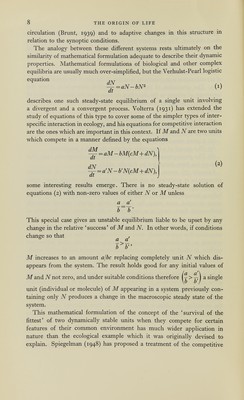
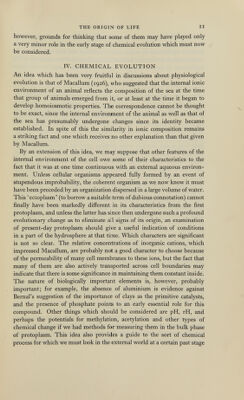
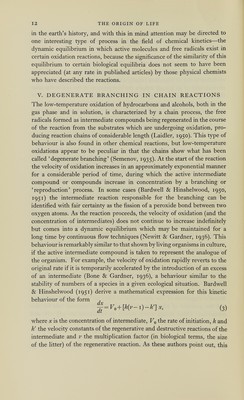
    8 THE ORIGIN OF LIFE circulation (Brunt, 1939) and to adaptive changes in this structure in relation to the synoptic conditions. The analogy between these different systems rests ultimately on the similarity of mathematical formulation adequate to describe their dynamic properties. Mathematical formulations of biological and other complex equilibria are usually much over-simplified, but the Verhulst-Pearl logistic equation (I) at describes one such steady-state equilibrium of a single unit involving a divergent and a convergent process. Volterra (1931) has extended the study of equations of this type to cover some of the simpler types of inter¬ specific interaction in ecology, and his equations for competitive interaction are the ones which are important in this context. If M and N are two units which compete in a manner defined by the equations ^ = аМ-ЬМ{сМ+ dN), ^=a'N-b'N{cM+dN), (2) some interesting results emerge. There is no steady-state solution of equations (2) with non-zero values of either N or M unless a a' b b' This special case gives an unstable equilibrium liable to be upset by any change in the relative 'success' of M and N. In other words, if conditions change so that a a b^b M increases to an amount ajbc replacing completely unit N which dis¬ appears from the system. The result holds good for any initial values of M and N not zero, and under suitable conditions therefore ^ single unit (individual or molecule) of M appearing in a system previously con¬ taining only N produces a change in the macroscopic steady state of the system. This mathematical formulation of the concept of the 'survival of the fittest' of two dynamically stable units when they compete for certain features of their common environment has much wider application in nature than the ecological example which it was originally devised to explain. Spiegelman (1948) has proposed a treatment of the competitive
    page 7
    31
    page 8
    32
    page 9
    33
    page 10
    34
    page 11
    35
    page 12
    36
    Previous page
    Next page

    Wellcome Collection

    183 Euston Road
    London NW1 2BE

    +44 (0)20 7611 2222
    info@wellcomecollection.org

    • Getting here

    Today’s opening times

    • Galleries
      10:00 – 18:00
    • Library
      10:00 – 18:00
    • Café
      10:00 – 18:00
    • Shop
      10:00 – 18:00

    Opening times

    Our building has:

    • Step free access
    • Hearing loops

    Accessibility

    • Visit us
    • What’s on
    • Stories
    • Collections
    • Get involved
    • About us
    • Contact us
    • Jobs
    • Media office
    • Developers
    • Privacy and terms
    • Cookie policy
    • Manage cookies
    • Modern slavery statement
    TikTok
    Facebook
    Instagram
    YouTube

    Except where otherwise noted, content on this site is licensed under a Creative Commons Attribution 4.0 International Licence