Wellcome Collection homepage
  • Visit us
  • What’s on
  • Stories
  • Collections
  • Get involved
  • About us
Sign in to your library account
Search for anything
Library account
Take me back to the item page

Evolution.

  • Society for Experimental Biology
Date:
1953
Catalogue details

Licence: Attribution-NonCommercial-NoDerivatives 4.0 International (CC BY-NC-ND 4.0)

Credit: Evolution. Source: Wellcome Collection.

  • Front Cover
  • Title Page
  • Table of Contents
  • Back Cover
    33/484 (page 9)
    Previous page
    Next page
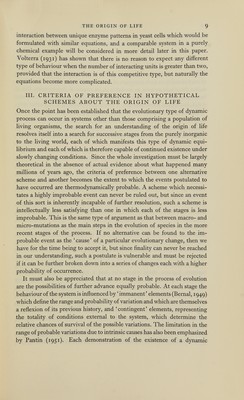
    THE ORIGIN OF LIFE 9 interaction between unique enzyme patterns in yeast cells which would be formulated with similar equations, and a comparable system in a purely chemical example will be considered in more detail later in this paper. Volterra (1931) has shown that there is no reason to expect any different type of behaviour when the number of interacting units is greater than two, provided that the interaction is of this competitive type, but naturally the equations become more complicated. III. CRITERIA OF PREFERENCE IN HYPOTHETICAL SCHEMES ABOUT THE ORIGIN OF LIFE Once the point has been established that the evolutionary type of dynamic process can occur in systems other than those comprising a population of living organisms, the search for an understanding of the origin of life resolves itself into a search for successive stages from the purely inorganic to the living world, each of which manifests this type of dynamic equi¬ librium and each of which is therefore capable of continued existence under slowly changing conditions. Since the whole investigation must be largely theoretical in the absence of actual evidence about what happened many millions of years ago, the criteria of preference between one alternative scheme and another becomes the extent to which the events postulated to have occurred are thermodynamically probable. A scheme which necessi¬ tates a highly improbable event can never be ruled out, but since an event of this sort is inherently incapable of further resolution, such a scheme is intellectually less satisfying than one in which each of the stages is less improbable. This is the same type of argument as that between macro- and micro-mutations as the main steps in the evolution of species in the more recent stages of the process. If no alternative can be found to the im¬ probable event as the 'cause' of a particular evolutionary change, then we have for the time being to accept it, but since finality can never be reached in our understanding, such a postulate is vulnerable and must be rejected if it can be further broken down into a series of changes each with a higher probability of occurrence. It must also be appreciated that at no stage in the process of evolution are the possibilities of further advance equally probable. At each stage the behaviour of the system is influenced by ' immanent ' elements (Bernal, 1949) which define the range and probability of variation and which are themselves a reflexion of its previous history, and 'contingent' elements, representing the totality of conditions external to the system, which determine the relative chances of survival of the possible variations. The limitation in the range of probable variations due to intrinsic causes has also been emphasized by Pantin (1951). Each demonstration of the existence of a dynamic
    page 7
    31
    page 8
    32
    page 9
    33
    page 10
    34
    page 11
    35
    page 12
    36
    Previous page
    Next page

    Wellcome Collection

    183 Euston Road
    London NW1 2BE

    +44 (0)20 7611 2222
    info@wellcomecollection.org

    • Getting here

    Today’s opening times

    • Galleries
      10:00 – 18:00
    • Library
      10:00 – 18:00
    • Café
      10:00 – 18:00
    • Shop
      10:00 – 18:00

    Opening times

    Our building has:

    • Step free access
    • Hearing loops

    Accessibility

    • Visit us
    • What’s on
    • Stories
    • Collections
    • Get involved
    • About us
    • Contact us
    • Jobs
    • Media office
    • Developers
    • Privacy and terms
    • Cookie policy
    • Manage cookies
    • Modern slavery statement
    TikTok
    Facebook
    Instagram
    YouTube

    Except where otherwise noted, content on this site is licensed under a Creative Commons Attribution 4.0 International Licence