Wellcome Collection homepage
  • Visit us
  • What’s on
  • Stories
  • Collections
  • Get involved
  • About us
Sign in to your library account
Search for anything
Library account
Take me back to the item page

Evolution.

  • Society for Experimental Biology
Date:
1953
Catalogue details

Licence: Attribution-NonCommercial-NoDerivatives 4.0 International (CC BY-NC-ND 4.0)

Credit: Evolution. Source: Wellcome Collection.

  • Front Cover
  • Title Page
  • Table of Contents
  • Back Cover
    34/484 (page 10)
    Previous page
    Next page
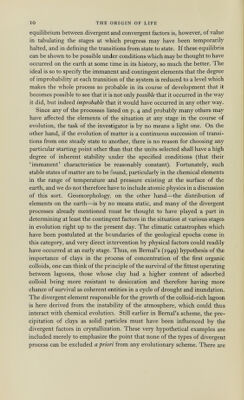
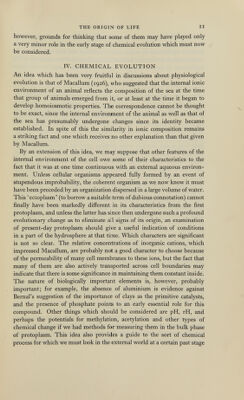
    IO THE ORIGIN OF LIFE equilibrium between divergent and convergent factors is, however, of value in tabulating the stages at which progress may have been temporarily halted, and in defining the transitions from state to state. If these equilibria can be shown to be possible under conditions which may be thought to have occurred on the earth at some time in its history, so much the better. The ideal is so to specify the immanent and contingent elements that the degree of improbability at each transition of the system is reduced to a level which makes the whole process so probable in its course of development that it becomes possible to see that it is not otAj possible that it occurred in the way it did, but indeed improbable that it would have occurred in any other way. Since any of the processes listed on p. 4 and probably many others may have affected the elements of the situation at any stage in the course of evolution, the task of the investigator is by no means a light one. On the other hand, if the evolution of matter is a continuous succession of transi¬ tions from one steady state to another, there is no reason for choosing any particular starting point other than that the units selected shall have a high degree of inherent stability under the specified conditions (that their 'immanent' characteristics be reasonably constant). Fortunately, such stable states of matter are to be found, particularly in the chemical elements in the range of temperature and pressure existing at the surface of the earth, and we do not therefore have to include atomic physics in a discussion of this sort. Geomorphology, on the other hand—the distribution of elements on the earth—is by no means static, and many of the divergent processes already mentioned must be thought to have played a part in determining at least the contingent factors in the situation at various stages in evolution right up to the present day. The climatic catastrophes which have been postulated at the boundaries of the geological epochs come in this category, and very direct intervention by physical factors could readily have occurred at an early stage. Thus, on Bemal's (1949) hypothesis of the importance of clays in the process of concentration of the first organic colloids, one can think of the principle of the survival of the fittest operating between lagoons, those whose clay had a higher content of adsorbed colloid being more resistant to desiccation and therefore having more chance of survival as coherent entities in a cycle of drought and inundation. The divergent element responsible for the growth of the colloid-rich lagoon is here derived from the instability of the atmosphere, which could thus interact with chemical evolution. Still earlier in Bemal's scheme, the pre¬ cipitation of clays as solid particles must have been influenced by the divergent factors in crystallization. These very hypothetical examples are included merely to emphasize the point that none of the types of divergent process can be excluded a priori from any evolutionary scheme. There are
    page 7
    31
    page 8
    32
    page 9
    33
    page 10
    34
    page 11
    35
    page 12
    36
    Previous page
    Next page

    Wellcome Collection

    183 Euston Road
    London NW1 2BE

    +44 (0)20 7611 2222
    info@wellcomecollection.org

    • Getting here

    Today’s opening times

    • Galleries
      10:00 – 18:00
    • Library
      10:00 – 18:00
    • Café
      10:00 – 18:00
    • Shop
      10:00 – 18:00

    Opening times

    Our building has:

    • Step free access
    • Hearing loops

    Accessibility

    • Visit us
    • What’s on
    • Stories
    • Collections
    • Get involved
    • About us
    • Contact us
    • Jobs
    • Media office
    • Developers
    • Privacy and terms
    • Cookie policy
    • Manage cookies
    • Modern slavery statement
    TikTok
    Facebook
    Instagram
    YouTube

    Except where otherwise noted, content on this site is licensed under a Creative Commons Attribution 4.0 International Licence