Wellcome Collection homepage
  • Visit us
  • What’s on
  • Stories
  • Collections
  • Get involved
  • About us
Sign in to your library account
Search for anything
Library account
Take me back to the item page

Evolution.

  • Society for Experimental Biology
Date:
1953
Catalogue details

Licence: Attribution-NonCommercial-NoDerivatives 4.0 International (CC BY-NC-ND 4.0)

Credit: Evolution. Source: Wellcome Collection.

  • Front Cover
  • Title Page
  • Table of Contents
  • Back Cover
    35/484 (page 11)
    Previous page
    Next page
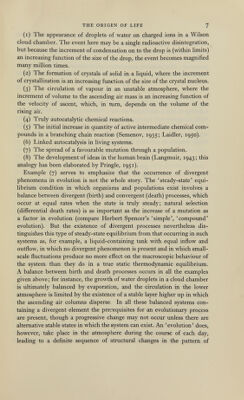
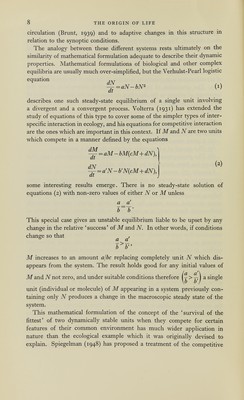
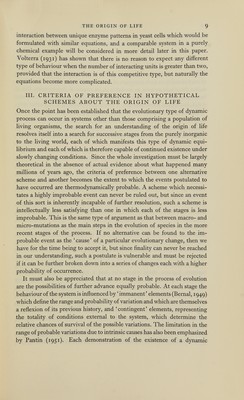
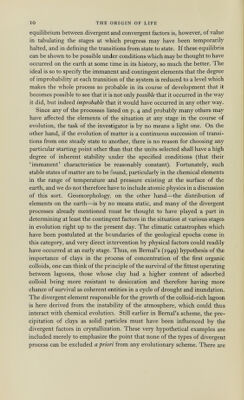
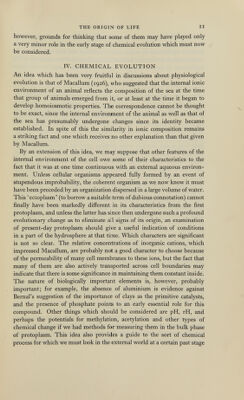
    THE ORIGIN OF LIFE II however, grounds for thinking that some of them may have played only a very minor role in the early stage of chemical evolution which must now be considered. IV. CHEMICAL EVOLUTION An idea which has been very fruitful in discussions about physiological evolution is that of Macallum (1926), who suggested that the internal ionic environment of an animal reflects the composition of the sea at the time that group of animals emerged from it, or at least at the time it began to develop homoiosmotic properties. The correspondence cannot be thought to be exact, since the internal environment of the animal as well as that of the sea has presumably undergone changes since its identity became established. In spite of this the similarity in ionic composition remains a striking fact and one which receives no other explanation than that given by Macallum. By an extension of this idea, we may suppose that other features of the internal environment of the cell owe some of their characteristics to the fact that it was at one time continuous with an external aqueous environ¬ ment. Unless cellular organisms appeared fully formed by an event of stupendous improbability, the coherent organism as we now know it must have been preceded by an organization dispersed in a large volume of water. This 'ectoplasm' (to borrow a suitable term of dubious connotation) cannot finally have been markedly different in its characteristics from the first protoplasm, and unless the latter has since then undergone such a profound evolutionary change as to eliminate all signs of its origin, an examination of present-day protoplasm should give a useful indication of conditions in a part of the hydrosphere at that time. Which characters are significant is not so clear. The relative concentrations of inorganic cations, which impressed Macallum, are probably not a good character to choose because of the permeability of many cell membranes to these ions, but the fact that many of them are also actively transported across cell boundaries may indicate that there is some significance in maintaining them constant inside. The nature of biologically important elements is, however, probably important; for example, the absence of aluminium is evidence against Bernal's suggestion of the importance of clays as the primitive catalysts, and the presence of phosphate points to an early essential role for this compound. Other things which should be considered are pH, rH, and perhaps the potentials for methylation, acetylation and other types of chemical change if we had methods for measuring them in the bulk phase of protoplasm. This idea also provides a guide to the sort of chemical process for which we must look in the external world at a certain past stage
    page 7
    31
    page 8
    32
    page 9
    33
    page 10
    34
    page 11
    35
    page 12
    36
    Previous page
    Next page

    Wellcome Collection

    183 Euston Road
    London NW1 2BE

    +44 (0)20 7611 2222
    info@wellcomecollection.org

    • Getting here

    Today’s opening times

    • Galleries
      10:00 – 18:00
    • Library
      10:00 – 18:00
    • Café
      10:00 – 18:00
    • Shop
      10:00 – 18:00

    Opening times

    Our building has:

    • Step free access
    • Hearing loops

    Accessibility

    • Visit us
    • What’s on
    • Stories
    • Collections
    • Get involved
    • About us
    • Contact us
    • Jobs
    • Media office
    • Developers
    • Privacy and terms
    • Cookie policy
    • Manage cookies
    • Modern slavery statement
    TikTok
    Facebook
    Instagram
    YouTube

    Except where otherwise noted, content on this site is licensed under a Creative Commons Attribution 4.0 International Licence