Wellcome Collection homepage
  • Visit us
  • What’s on
  • Stories
  • Collections
  • Get involved
  • About us
Sign in to your library account
Search for anything
Library account
Take me back to the item page

Evolution.

  • Society for Experimental Biology
Date:
1953
Catalogue details

Licence: Attribution-NonCommercial-NoDerivatives 4.0 International (CC BY-NC-ND 4.0)

Credit: Evolution. Source: Wellcome Collection.

  • Front Cover
  • Title Page
  • Table of Contents
  • Back Cover
    36/484 (page 12)
    Previous page
    Next page
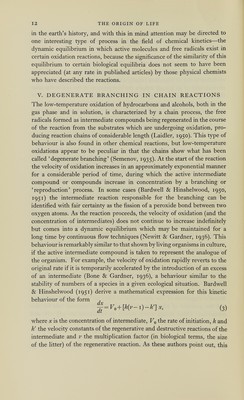
    12 THE ORIGIN OF LIFE in the earth's history, and with this in mind attention may be directed to one interesting type of process in the field of chemical kinetics—the dynamic equilibrium in which active molecules and free radicals exist in certain oxidation reactions, because the significance of the similarity of this equilibrium to certain biological equilibria does not seem to have been appreciated (at any rate in published articles) by those physical chemists who have described the reactions. V. DEGENERATE BRANCHING IN CHAIN REACTIONS The low-temperature oxidation of hydrocarbons and alcohols, both in the gas phase and in solution, is characterized by a chain process, the free radicals formed as intermediate compounds being regenerated in the course of the reaction from the substrates which are undergoing oxidation, pro¬ ducing reaction chains of considerable length (Laidler, 1950). This type of behaviour is also found in other chemical reactions, but low-temperature oxidations appear to be peculiar in that the chains show what has been called 'degenerate branching' (Semenov, 1935). At the start of the reaction the velocity of oxidation increases in an approximately exponential manner for a considerable period of time, during which the active intermediate compound or compounds increase in concentration by a branching or 'reproduction' process. In some cases (Bardwell & Hinshelwood, 1950, 1951) the intermediate reaction responsible for the branching can be identified with fair certainty as the fission of a peroxide bond between two oxygen atoms. As the reaction proceeds, the velocity of oxidation (and the concentration of intermediates) does not continue to increase indefinitely but comes into a dynamic equilibrium which may be maintained for a long time by continuous flow techniques (Newitt & Gardner, 1936). This behaviour is remarkably similar to that shown by living organisms in culture, if the active intermediate compound is taken to represent the analogue of the organism. For example, the velocity of oxidation rapidly reverts to the original rate if it is temporarily accelerated by the introduction of an excess of an intermediate (Bone & Gardner, 1936), a behaviour similar to the stability of numbers of a species in a given ecological situation. Bardwell & Hinshelwood (1951) derive a mathematical expression for this kinetic behaviour of the form , + (3) where x is the concentration of intermediate, Vq the rate of initiation, k and k' the velocity constants of the regenerative and destructive reactions of the intermediate and v the multiplication factor (in biological terms, the size of the litter) of the regenerative reaction. As these authors point out, this
    page 7
    31
    page 8
    32
    page 9
    33
    page 10
    34
    page 11
    35
    page 12
    36
    Previous page
    Next page

    Wellcome Collection

    183 Euston Road
    London NW1 2BE

    +44 (0)20 7611 2222
    info@wellcomecollection.org

    • Getting here

    Today’s opening times

    • Galleries
      10:00 – 18:00
    • Library
      10:00 – 18:00
    • Café
      10:00 – 18:00
    • Shop
      10:00 – 18:00

    Opening times

    Our building has:

    • Step free access
    • Hearing loops

    Accessibility

    • Visit us
    • What’s on
    • Stories
    • Collections
    • Get involved
    • About us
    • Contact us
    • Jobs
    • Media office
    • Developers
    • Privacy and terms
    • Cookie policy
    • Manage cookies
    • Modern slavery statement
    TikTok
    Facebook
    Instagram
    YouTube

    Except where otherwise noted, content on this site is licensed under a Creative Commons Attribution 4.0 International Licence