Wellcome Collection homepage
  • Visit us
  • What’s on
  • Stories
  • Collections
  • Get involved
  • About us
Sign in to your library account
Search for anything
Library account
Take me back to the item page

Evolution.

  • Society for Experimental Biology
Date:
1953
Catalogue details

Licence: Attribution-NonCommercial-NoDerivatives 4.0 International (CC BY-NC-ND 4.0)

Credit: Evolution. Source: Wellcome Collection.

  • Front Cover
  • Title Page
  • Table of Contents
  • Back Cover
    37/484 (page 13)
    Previous page
    Next page
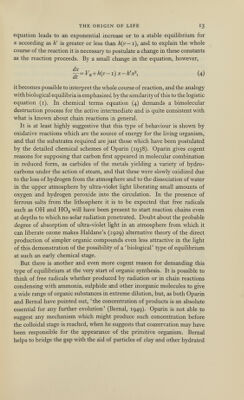
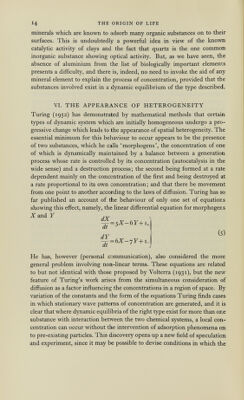
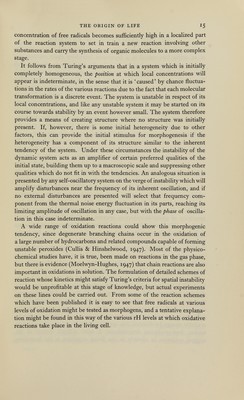
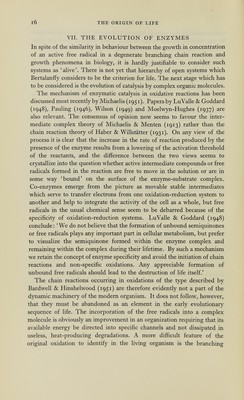
    THE ORIGIN OF LIFE 13 equation leads to an exponential increase or to a stable equilibrium for X according as k' is greater or less than k{v— i), and to explain the whole course of the reaction it is necessary to postulate a change in these constants as the reaction proceeds. By a small change in the equation, however, ^=V„ + k{v-i)x-k'x\ (4) it becomes possible to interpret the whole course of reaction, and the analogy with biological equilibria is emphasized by the similarity of this to the logistic equation (i). In chemical terms equation (4) demands a bimolecular destruction process for the active intermediate and is quite consistent with what is known about chain reactions in general. It is at least highly suggestive that this type of behaviour is shown by oxidative reactions which are the source of energy for the living organism, and that the substrates required are just those which have been postulated by the detailed chemical schemes of Oparin (1938). Oparin gives cogent reasons for supposing that carbon first appeared in molecular combination in reduced form, as carbides of the metals yielding a variety of hydro¬ carbons under the action of steam, and that these were slowly oxidized due to the loss of hydrogen from the atmosphere and to the dissociation of water in the upper atmosphere by ultra-violet light liberating small amounts of oxygen and hydrogen peroxide into the circulation. In the presence of ferrous salts from the lithosphère it is to be expected that free radicals such as OH and HOg will have been present to start reaction chains even at depths to which no solar radiation penetrated. Doubt about the probable degree of absorption of ultra-violet light in an atmosphere from which it can liberate ozone makes Haldane's (1929) alternative theory of the direct production of simpler organic compounds even less attractive in the light of this demonstration of the possibility of a ' biological ' type of equilibrium at such an early chemical stage. But there is another and even more cogent reason for demanding this type of equilibrium at the very start of organic synthesis. It is possible to think of free radicals whether produced by radiation or in chain reactions condensing with ammonia, sulphide and other inorganic molecules to give a wide range of organic substances in extreme dilution, but, as both Oparin and Bemal have pointed out, ' the concentration of products is an absolute essential for any further evolution' (Bernal, 1949). Oparin is not able to suggest any mechanism which might produce such concentration before the colloidal stage is reached, when he suggests that coazervation may have been responsible for the appearance of the primitive organism. Bernal helps to bridge the gap with the aid of particles of clay and other hydrated
    page 13
    37
    page 14
    38
    page 15
    39
    page 16
    40
    page 17
    41
    page 18
    42
    Previous page
    Next page

    Wellcome Collection

    183 Euston Road
    London NW1 2BE

    +44 (0)20 7611 2222
    info@wellcomecollection.org

    • Getting here

    Today’s opening times

    • Galleries
      10:00 – 18:00
    • Library
      10:00 – 18:00
    • Café
      10:00 – 18:00
    • Shop
      10:00 – 18:00

    Opening times

    Our building has:

    • Step free access
    • Hearing loops

    Accessibility

    • Visit us
    • What’s on
    • Stories
    • Collections
    • Get involved
    • About us
    • Contact us
    • Jobs
    • Media office
    • Developers
    • Privacy and terms
    • Cookie policy
    • Manage cookies
    • Modern slavery statement
    TikTok
    Facebook
    Instagram
    YouTube

    Except where otherwise noted, content on this site is licensed under a Creative Commons Attribution 4.0 International Licence