Wellcome Collection homepage
  • Visit us
  • What’s on
  • Stories
  • Collections
  • Get involved
  • About us
Sign in to your library account
Search for anything
Library account
Take me back to the item page

Evolution.

  • Society for Experimental Biology
Date:
1953
Catalogue details

Licence: Attribution-NonCommercial-NoDerivatives 4.0 International (CC BY-NC-ND 4.0)

Credit: Evolution. Source: Wellcome Collection.

  • Front Cover
  • Title Page
  • Table of Contents
  • Back Cover
    38/484 (page 14)
    Previous page
    Next page
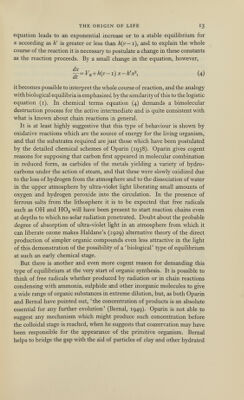
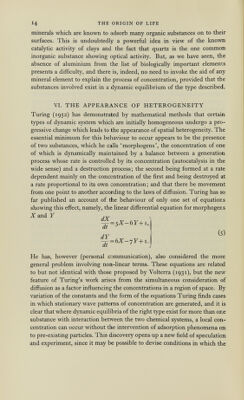
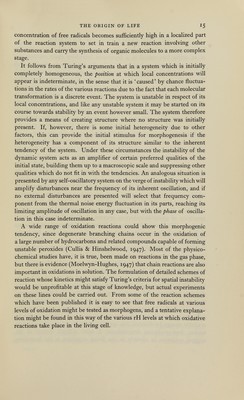
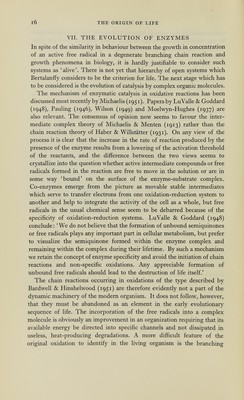
    H THE ORIGIN OF LIFE minerals which are known to adsorb many organic substances on to their surfaces. This is undoubtedly a powerful idea in view of the known catalytic activity of clays and the fact that quartz is the one common inorganic substance showing optical activity. But, as we have seen, the absence of aluminium from the list of biologically important elements presents a difficulty, and there is, indeed, no need to invoke the aid of any mineral element to explain the process of concentration, provided that the substances involved exist in a dynamic equilibrium of the type described. VL THE APPEARANCE OF HETEROGENEITY Turing (1952) has demonstrated by mathematical methods that certain types of dynamic system which are initially homogeneous undergo a pro¬ gressive change which leads to the appearance of spatial heterogeneity. The essential minimum for this behaviour to occur appears to be the presence of two substances, which he calls 'morphogens', the concentration of one of which is dynamically maintained by a balance between a generation process whose rate is controlled by its concentration (autocatalysis in the wide sense) and a destruction process; the second being formed at a rate dependent mainly on the concentration of the first and being destroyed at a rate proportional to its own concentration ; and that there be movement from one point to another according to the laws of diffusion. Turing has so far published an account of the behaviour of only one set of equations showing this effect, namely, the linear differential equation for morphogens He has, however (personal communication), also considered the more general problem involving non-linear terms. These equations are related to but not identical with those proposed by Volterra (1931), but the new feature of Turing's work arises from the simultaneous consideration of diffusion as a factor influencing the concentrations in a region of space. By variation of the constants and the form of the equations Turing finds cases in which stationary wave patterns of concentration are generated, and it is clear that where dynamic equilibria of the right type exist for more than one substance with interaction between the two chemical systems, a local con¬ centration can occur without the intervention of adsorption phenomena on to pre-existing particles. This discovery opens up a new field of speculation and experiment, since it may be possible to devise conditions in which the XandY f is) J
    page 13
    37
    page 14
    38
    page 15
    39
    page 16
    40
    page 17
    41
    page 18
    42
    Previous page
    Next page

    Wellcome Collection

    183 Euston Road
    London NW1 2BE

    +44 (0)20 7611 2222
    info@wellcomecollection.org

    • Getting here

    Today’s opening times

    • Galleries
      10:00 – 18:00
    • Library
      10:00 – 18:00
    • Café
      10:00 – 18:00
    • Shop
      10:00 – 18:00

    Opening times

    Our building has:

    • Step free access
    • Hearing loops

    Accessibility

    • Visit us
    • What’s on
    • Stories
    • Collections
    • Get involved
    • About us
    • Contact us
    • Jobs
    • Media office
    • Developers
    • Privacy and terms
    • Cookie policy
    • Manage cookies
    • Modern slavery statement
    TikTok
    Facebook
    Instagram
    YouTube

    Except where otherwise noted, content on this site is licensed under a Creative Commons Attribution 4.0 International Licence