Wellcome Collection homepage
  • Visit us
  • What’s on
  • Stories
  • Collections
  • Get involved
  • About us
Sign in to your library account
Search for anything
Library account
Take me back to the item page

Evolution.

  • Society for Experimental Biology
Date:
1953
Catalogue details

Licence: Attribution-NonCommercial-NoDerivatives 4.0 International (CC BY-NC-ND 4.0)

Credit: Evolution. Source: Wellcome Collection.

  • Front Cover
  • Title Page
  • Table of Contents
  • Back Cover
    39/484 (page 15)
    Previous page
    Next page
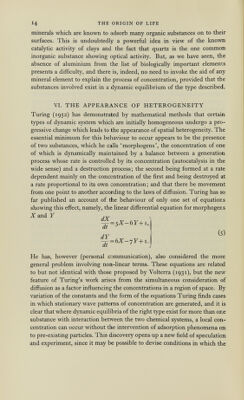
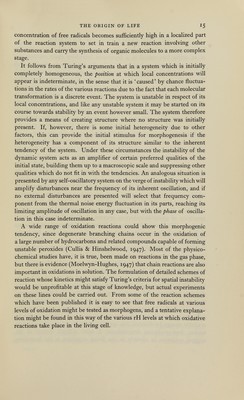
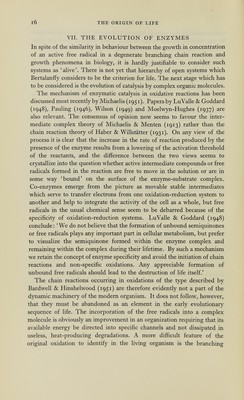
    THE ORIGIN OF LIFE 15 concentration of free radicals becomes sufficiently high in a localized part of the reaction system to set in train a new reaction involving other substances and carry the synthesis of organic molecules to a more complex stage. It follows from Turing's arguments that in a system which is initially completely homogeneous, the position at which local concentrations will appear is indeterminate, in the sense that it is ' caused ' by chance fluctua¬ tions in the rates of the various reactions due to the fact that each molecular transformation is a discrete event. The system is unstable in respect of its local concentrations, and like any unstable system it may be started on its course towards stability by an event however small. The system therefore provides a means of creating structure where no structure was initially present. If, however, there is some initial heterogeneity due to other factors, this can provide the initial stimulus for morphogenesis if the heterogeneity has a component of its structure similar to the inherent tendency of the system. Under these circumstances the instability of the dynamic system acts as an amplifier of certain preferred qualities of the initial state, building them up to a macroscopic scale and suppressing other qualities which do not fit in with the tendencies. An analogous situation is presented by any self-oscillatory system on the verge of instability which will amplify disturbances near the frequency of its inherent oscillation, and if no external disturbances are presented will select that frequency com¬ ponent from the thermal noise energy fluctuation in its parts, reaching its limiting amplitude of oscillation in any case, but with the phase of oscilla¬ tion in this case indeterminate. A wide range of oxidation reactions could show this morphogenic tendency, since degenerate branching chains occur in the oxidation of a large number of hydrocarbons and related compounds capable of forming unstable peroxides (Cullis & Hinshelwood, 1947). Most of the physico- chemical studies have, it is true, been made on reactions in the gas phase, but there is evidence (Moelwyn-Hughes, 1947) that chain reactions are also important in oxidations in solution. The formulation of detailed schemes of reaction whose kinetics might satisfy Turing's criteria for spatial instability would be unprofitable at this stage of knowledge, but actual experiments on these lines could be carried out. From some of the reaction schemes which have been published it is easy to see that free radicals at various levels of oxidation might be tested as morphogens, and a tentative explana¬ tion might be found in this way of the various rH levels at which oxidative reactions take place in the living cell.
    page 13
    37
    page 14
    38
    page 15
    39
    page 16
    40
    page 17
    41
    page 18
    42
    Previous page
    Next page

    Wellcome Collection

    183 Euston Road
    London NW1 2BE

    +44 (0)20 7611 2222
    info@wellcomecollection.org

    • Getting here

    Today’s opening times

    • Galleries
      10:00 – 18:00
    • Library
      10:00 – 18:00
    • Café
      10:00 – 18:00
    • Shop
      10:00 – 18:00

    Opening times

    Our building has:

    • Step free access
    • Hearing loops

    Accessibility

    • Visit us
    • What’s on
    • Stories
    • Collections
    • Get involved
    • About us
    • Contact us
    • Jobs
    • Media office
    • Developers
    • Privacy and terms
    • Cookie policy
    • Manage cookies
    • Modern slavery statement
    TikTok
    Facebook
    Instagram
    YouTube

    Except where otherwise noted, content on this site is licensed under a Creative Commons Attribution 4.0 International Licence