Wellcome Collection homepage
  • Visit us
  • What’s on
  • Stories
  • Collections
  • Get involved
  • About us
Sign in to your library account
Search for anything
Library account
Take me back to the item page

Evolution.

  • Society for Experimental Biology
Date:
1953
Catalogue details

Licence: Attribution-NonCommercial-NoDerivatives 4.0 International (CC BY-NC-ND 4.0)

Credit: Evolution. Source: Wellcome Collection.

  • Front Cover
  • Title Page
  • Table of Contents
  • Back Cover
    41/484 (page 17)
    Previous page
    Next page
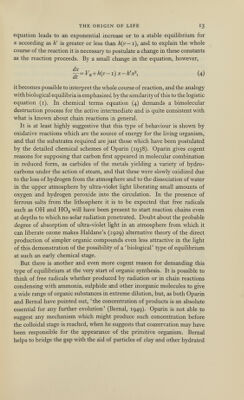
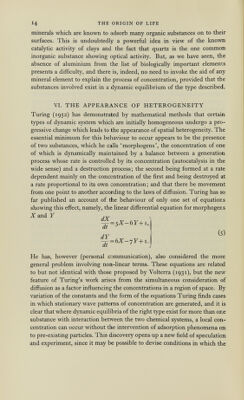
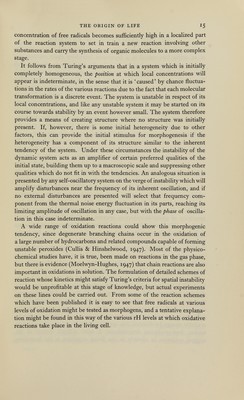
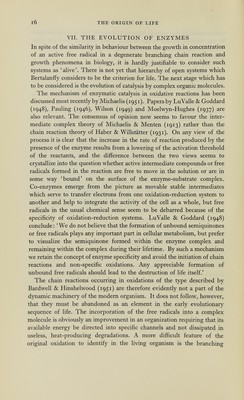
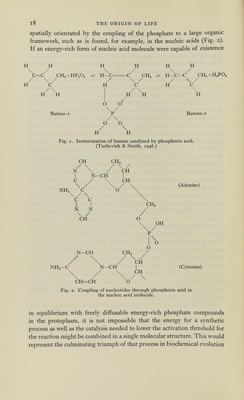
    THE ORIGIN OF LIFE I7 feature which is also essential for the generation of the type of equilibrium required for morphogenesis. If the free radical is bound in the enzyme molecule, it follows that the autocatalytic growth process must apply to the molecule as a whole if the character if the equilibrium is to be preserved. If the enzyme molecule is regarded as a framework carrying the free radical, the framework must grow as well as the radical. There is evidence that this overall enzyme growth does occur in cells, in the literature on enzymatic adaptation (Monod, 1947; Spiegelman, 1946, 1948; Delbrück, 1941 ; Hinshelwood, 1946). When a micro-organism with the potentiality for utilizing an unusual substrate is first transferred to a medium containing this substrate, its growth increases in a manner which strongly suggests an autocatalytic increase in the enzyme or enzyme system concerned. Monod (1947), in a comprehensive review of these phenomena, gives convincing grounds for such an interpretation, based on experiments involving competitive interaction between substrates and the use of as a tracer to measure the turn-over of nucleoprotein. Although he is at pains to point out that ' autocatalytic is by no means equivalent to self-reproducing', he leans decidedly towards the concept introduced by Spiegelman of such adaptation as the property of a population of self- reproducing units (plasmagenes) existing in a dynamic equilibrium of the type which we have seen to be necessary for an evolutionary process. The steps from the free radical of a branching chain oxidation to the activated enzyme-substrate complex increasing autocatalytically as a result of a complex interlocked series of reactions in the living cell cannot yet be conjectured. Nevertheless, one biochemical feature seems to be worth re-emphasizing (Schäfer, 1912), if only because it has not been brought into the picture by Oparin (1938) or Bernal (1949). The linkage of energy- yielding reactions and synthetic and other teleologically significant pro¬ cesses in living organisms seems to take place to a considerable extent through the agency of the phosphate radical, whose bond energy when in combination with other substances can vary over a range of some 14,000 cal./mole. This chemical energy is known to be used as a labile readily available store in such freely diffusing substances as ATP and the Phosphagens, and it is probably significant that coenzymes i and 11 and the nucleic acids also contain phosphate. Turkevich & Smith (1946) have shown in at least one example that phosphoric acid catalyses a molecular rearrangement by the simultaneous removal of hydrogen from one part of the substrate molecule and the addition of hydrogen to another part, the phosphoric acid being unchanged after the double exchange (Fig. i). Transfer of a hydrogen atom from one molecule to another might occur in this way if the two substrates were EBS VII 2
    page 13
    37
    page 14
    38
    page 15
    39
    page 16
    40
    page 17
    41
    page 18
    42
    Previous page
    Next page

    Wellcome Collection

    183 Euston Road
    London NW1 2BE

    +44 (0)20 7611 2222
    info@wellcomecollection.org

    • Getting here

    Today’s opening times

    • Galleries
      10:00 – 18:00
    • Library
      10:00 – 18:00
    • Café
      10:00 – 18:00
    • Shop
      10:00 – 18:00

    Opening times

    Our building has:

    • Step free access
    • Hearing loops

    Accessibility

    • Visit us
    • What’s on
    • Stories
    • Collections
    • Get involved
    • About us
    • Contact us
    • Jobs
    • Media office
    • Developers
    • Privacy and terms
    • Cookie policy
    • Manage cookies
    • Modern slavery statement
    TikTok
    Facebook
    Instagram
    YouTube

    Except where otherwise noted, content on this site is licensed under a Creative Commons Attribution 4.0 International Licence