Wellcome Collection homepage
  • Visit us
  • What’s on
  • Stories
  • Collections
  • Get involved
  • About us
Sign in to your library account
Search for anything
Library account
Take me back to the item page

Evolution.

  • Society for Experimental Biology
Date:
1953
Catalogue details

Licence: Attribution-NonCommercial-NoDerivatives 4.0 International (CC BY-NC-ND 4.0)

Credit: Evolution. Source: Wellcome Collection.

  • Front Cover
  • Title Page
  • Table of Contents
  • Back Cover
    450/484 (page 418)
    Previous page
    Next page
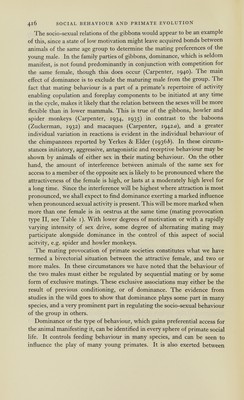
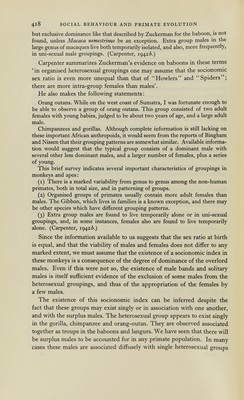
    420 SOCIAL BEHAVIOUR AND PRIMATE EVOLUTION females coming into heat. Unlike the baboon females, which remain attached to one male in a number proportional to the dominance of the male, macaque females, after exhausting the copulatory potentialities of a low-ranking male, solicit the attention of other males higher up the scale by aggressive as well as sexually assertive behaviour. The change in their social status often calls forth attacks by still more dominant males, but in these encounters the male to whom the advance has been made often remains neutral. Moreover, his reluctance immediately to respond sexually is considered by Carpenter to be an expression of the restraining influence of the male dominance hierarchy on the behaviour of the subordinate males. It is possible, therefore, to show that the social relations of mature males is regulated by the dominance of one male over another in all species of infra-human primates on which observations have been made in the wild or in comparable free-ranging conditions. This dominance is exerted by threat which in many instances is directed by facial expression, but which may also be expressed in the body posture of the high-ranking males (Carpenter, private communication). The existence of relatively prolonged periods of stable relations within the group must, therefore, be ascribed to the dominance relations within it, and this implies in turn that one animal is suppressing his approach with respect to another. (b) Spatial behaviour patterns The factors that have been identified in primate societies provide the essential elements of conflict, as this was defined earlier. The sexual attractiveness of the female is matched and balanced by the threat of a more dominant male. It should, therefore, be possible to describe the social behaviour of primates in spatial terms, similar to those we found adequate for orientation behaviour about a single object where this is also the site of goal achievement. Zuckerman's description of the baboons suggests this. 'Family parties move independently of one another, and seldom come into contact. They act as separate groups in all their activities as a rule, mingling with other members of the colony only when engaged in communal feeding, or when participating in some quarrel ' (Zuckerman, 1932). Carpenter has described the characteristics in a way which confirms this inference ; An important clue to social relations in primate societies is the observed spatial relation of individuals, sub-groups or organised groups. The strength of the attachment between two individuals may be judged, or actually measured, by observing for a period of time the average distance which separates the two animals. In group i of the Santiago Rhesus Colony, for example, the most dominant male and the next most dominant male were on the average less
    page 413
    445
    page 414
    446
    page 415
    447
    page 416
    448
    page 417
    449
    page 418
    450
    Previous page
    Next page

    Wellcome Collection

    183 Euston Road
    London NW1 2BE

    +44 (0)20 7611 2222
    info@wellcomecollection.org

    • Getting here

    Today’s opening times

    • Galleries
      10:00 – 18:00
    • Library
      10:00 – 18:00
    • Café
      10:00 – 18:00
    • Shop
      10:00 – 18:00

    Opening times

    Our building has:

    • Step free access
    • Hearing loops

    Accessibility

    • Visit us
    • What’s on
    • Stories
    • Collections
    • Get involved
    • About us
    • Contact us
    • Jobs
    • Media office
    • Developers
    • Privacy and terms
    • Cookie policy
    • Manage cookies
    • Modern slavery statement
    TikTok
    Facebook
    Instagram
    YouTube

    Except where otherwise noted, content on this site is licensed under a Creative Commons Attribution 4.0 International Licence