Wellcome Collection homepage
  • Visit us
  • What’s on
  • Stories
  • Collections
  • Get involved
  • About us
Sign in to your library account
Search for anything
Library account
Take me back to the item page

Evolution.

  • Society for Experimental Biology
Date:
1953
Catalogue details

Licence: Attribution-NonCommercial-NoDerivatives 4.0 International (CC BY-NC-ND 4.0)

Credit: Evolution. Source: Wellcome Collection.

  • Front Cover
  • Title Page
  • Table of Contents
  • Back Cover
    457/484 (page 425)
    Previous page
    Next page
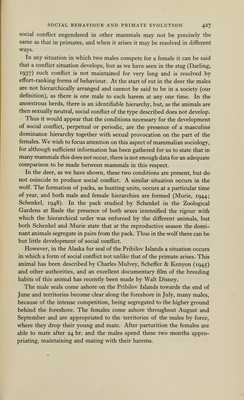
    SOCIAL BEHAVIOUR AND PRIMATE EVOLUTION 427 social conflict engendered in other mammals may not be precisely the same as that in primates, and when it arises it may be resolved in different ways. In any situation in which two males compete for a female it can be said that a conflict situation develops, but as we have seen in the stag (Darling, 1937) such conflict is not maintained for very long and is resolved by effort-ranking forms of behaviour. At the start of rut in the deer the males are not hierarchically arranged and cannot be said to be in a society (our definition), as there is one male to each harem at any one time. In the anoestrous herds, there is an identifiable hierarchy, but, as the animals are then sexually neutral, social conflict of the type described does not develop. Thus it would appear that the conditions necessary for the development of social conflict, perpetual or periodic, are the presence of a masculine dominance hierarchy together with sexual provocation on the part of the females. We wish to focus attention on this aspect of mammalian sociology, for although sufficient information has been gathered for us to state that in many mammals this does not occur, there is not enough data for an adequate comparison to be made between mammals in this respect. In the deer, as we have shown, these two conditions are present, but do not coincide to produce social conflict. A similar situation occurs in the wolf. The formation of packs, as hunting units, occurs at a particular time of year, and both male and female hierarchies are formed (Murie, 1944; Schenkel, 1948). In the pack studied by Schenkel in the Zoological Gardens at Basle the presence of both sexes intensified the rigour with which the hierarchical order was enforced by the different animals, but both Schenkel and Murie state that at the reproductive season the domi¬ nant animals segregate in pairs from the pack. Thus in the wolf there can be but little development of social conflict. However, in the Alaska fur seal of the Pribilov Islands a situation occurs in which a form of social conflict not unlike that of the primate arises. This animal has been described by Charles Mulvey, Scheffer & Kenyon (1945) and other authorities, and an excellent documentary film of the breeding habits of this animal has recently been made by Walt Disney. The male seals come ashore on the Pribilov Islands towards the end of June and territories become clear along the foreshore in July, many males, because of the intense competition, being segregated to the higher ground behind the foreshore. The females come ashore throughout August and September and are appropriated to the territories of the males by force, where they drop their young and mate. After parturition the females are able to mate after 24 hr. and the males spend these two months appro¬ priating, maintaining and mating with their harems.
    page 425
    457
    page 426
    458
    page 427
    459
    page 428
    460
    page 429
    461
    page 430
    462
    Previous page
    Next page

    Wellcome Collection

    183 Euston Road
    London NW1 2BE

    +44 (0)20 7611 2222
    info@wellcomecollection.org

    • Getting here

    Today’s opening times

    • Galleries
      10:00 – 18:00
    • Library
      10:00 – 18:00
    • Café
      10:00 – 18:00
    • Shop
      10:00 – 18:00

    Opening times

    Our building has:

    • Step free access
    • Hearing loops

    Accessibility

    • Visit us
    • What’s on
    • Stories
    • Collections
    • Get involved
    • About us
    • Contact us
    • Jobs
    • Media office
    • Developers
    • Privacy and terms
    • Cookie policy
    • Manage cookies
    • Modern slavery statement
    TikTok
    Facebook
    Instagram
    YouTube

    Except where otherwise noted, content on this site is licensed under a Creative Commons Attribution 4.0 International Licence