Wellcome Collection homepage
  • Visit us
  • What’s on
  • Stories
  • Collections
  • Get involved
  • About us
Sign in to your library account
Search for anything
Library account
Take me back to the item page

Evolution.

  • Society for Experimental Biology
Date:
1953
Catalogue details

Licence: Attribution-NonCommercial-NoDerivatives 4.0 International (CC BY-NC-ND 4.0)

Credit: Evolution. Source: Wellcome Collection.

  • Front Cover
  • Title Page
  • Table of Contents
  • Back Cover
    460/484 (page 428)
    Previous page
    Next page
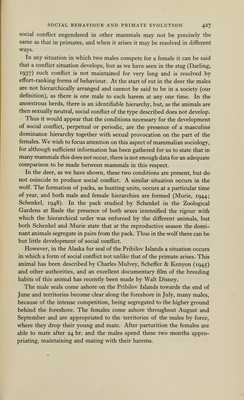
    43° SOCIAL BEHAVIOUR AND PRIMATE EVOLUTION evolution of man. There is, as we have stated, no complete evidence relating to this. The criteria for assessing the significance of neocortical enlargement is yet another open question. Which relation between parts of the central nervous system are of significance ? Whilst we feel that expressions of area, volume, or mass of parts of the cortex to brain or spinal cord would be of interest, they would be of doubtful evolutionary significance, in that increase in the size of parts of the brain in evolutionary development may only occur pari passu with similar developments in the rest of the brain. The structure and function of homologous parts also change in evolution (e.g. red nucleus); therefore, simple mass comparisons between such changing structures, or between ganglia and laminae, are not significant measures of evolutionary development, as the changes taking place in these structures are qualitative as well as quantitive. It is likely, however, that a comparison of the proportion of the different functional areas to the total cortical surface would be a measure which might be of more significance in evolutionary studies than encephalometric studies by themselves (von Bonin, 1941). This will be discussed in more detail later. It should be also borne in mind that with enlargement of the cortex a change in the functional relationships between it and other brain structures may have taken place. This change in the relationship between parts of the brain may also be of significance in this context. In the great majority of neurological studies, the animals have not been kept in conditions which would facilitate subsequent analysis of social behaviour following brain lesions. In many studies on primates, the experimental animals have been kept in cages, singly or in pairs, and subse¬ quently used in retention or aptitude tests for comparison with normal animals. Such investigations are of very great interest, but are not relevant to the questions raised here. In the remainder of this section such evidence as is relevant to this discussion will be presented. It must be remembered that the value of such a discussion depends largely upon the amount of general information available which, as we have attempted to show, is frequently lacking in relevant detail. On present evidence, it is virtually impossible to estimate the proportion of the neocortical surface subserving a particular function. This is because, as von Economo states (1926), two-thirds of the cortical surface resides in the sulci and most of the localization studies using strychninization or placed electrodes are confined to the remaining one-third which is exposed on the outer surface. On the assumption, however, that the sulci represent invaginations of the functional areas represented on the surface, it is clear that total autonomic representation in man's cortex is of a much higher
    page 425
    457
    page 426
    458
    page 427
    459
    page 428
    460
    page 429
    461
    page 430
    462
    Previous page
    Next page

    Wellcome Collection

    183 Euston Road
    London NW1 2BE

    +44 (0)20 7611 2222
    info@wellcomecollection.org

    • Getting here

    Today’s opening times

    • Galleries
      10:00 – 18:00
    • Library
      10:00 – 18:00
    • Café
      10:00 – 18:00
    • Shop
      10:00 – 18:00

    Opening times

    Our building has:

    • Step free access
    • Hearing loops

    Accessibility

    • Visit us
    • What’s on
    • Stories
    • Collections
    • Get involved
    • About us
    • Contact us
    • Jobs
    • Media office
    • Developers
    • Privacy and terms
    • Cookie policy
    • Manage cookies
    • Modern slavery statement
    TikTok
    Facebook
    Instagram
    YouTube

    Except where otherwise noted, content on this site is licensed under a Creative Commons Attribution 4.0 International Licence