The essentials of disinfection and sterilization by steam at high and low pressures / by S. Delépine.
- Delépine, S.
- Date:
- [1909]
Licence: In copyright
Credit: The essentials of disinfection and sterilization by steam at high and low pressures / by S. Delépine. Source: Wellcome Collection.
20/164 (page 12)
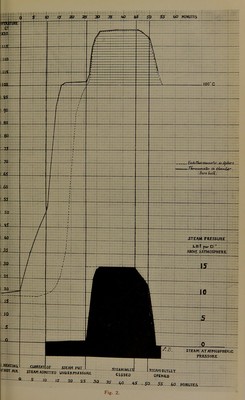
![by a cork. The two other openings are large, symmetrical, and dia- metrically opposite to each other (2). These large openings are guarded by two perforated lids which, when closed, complete the sphere. The sphere is divided into two equal halves by a jK^rforated wooden diaphragm (3), in which a channel is j^rovided to allow the bulb (4) of the thermometer to be placed centrally in the S])here. The diagram (Fig. i) shows how the thermometer is fixed. In the wall (7-7) of the steam chamber an opening is pro\dded for the passage of the stem of the thermometer ; the opening is closed bj^ means of a suitable screw cap (6) and indiarubber plug. The stenr of another thermometer passes through the same opening, and the bulb of that second thermometer penetrates into the steam chamber to the same depth as the bulb of the endothermometer ; it is brought close to one of the perforated doors through which the steam penetrates into the s])here. This second bulb remains bare, and takes the temperature of the steam or air outside the sphere. The thermometer bulbs and stems represented in the diagram are parts of two Richard thermo- graphs. By means of these well-constructed instruments it is possible to oljtain fairly accurate continuous records of temperatures and to compare the temperature of the bare with that of the covered bulb at \-ery short intervals. Certain errors are attached to these records, but they do not interfere very materially with the usefulness of the curves. I will suppose now that one wishes to ascertain the time required for current saturated steam at 100° C. to penetrate to the centre of a flock mattress 10 inches thick exposed in a disinfecting chamber. The weight and volume of the mattress are ascertained, and the amount of flock which a sphere 10 inches in diameter should contain (in order that the density of the flock in the sphere should correspond to that of the flock in the mattress) is calculated. (In one instance I found that li-lbs. of flock had to be packed in the sphere in order to obtain this result.) One half of the material is packed carefully into one half of the sphere, and the remaining half of the material is then packed into the other half of the sphere. The material must be distributed as evenly as possible. The doors of the sphere are then fastened. The bulb of the endothernioineter is now in the centre of a spherical mass of flock packed ^^ery much in the same way as it would be in the mattress. The steam chamber is then closed, steam is admitted to it, and the thermometers are watched. The curves reproduced on Fig. 2 show the results obtained in a large disinfecting chamber 6-ft. long and nearly 4-ft. in diameter. The chamber was in the first instance warmed by hot air, then an abundant current of saturated dry steam at ordinary atmospheric pressure, or slightly above it, was allowed to pass through the chamber until the temperature indicated by the bare bulb and the covered bulb were nearly the same ; after this the pressure of the steam was caused to rise ; finally the steam supply was cut off and a little later the steam in the chamber allowed to escape freely. These various stages are shown in the chart, a vertical line indicating the beginning of each stage (big- 2). The continuous black line shows the temperature recorded by the thermometer freely cx])osed in the steam chamber, the dotted line cives the temperature in the centre of the 10 inches sphere of flock, as recorded by the endothermometer. The lower curve gives the steam pressure. The space between the lower curve and the abscissa is painted black. The space between the 100° C. line and the tenipera-](https://iiif.wellcomecollection.org/image/b28069389_0020.jp2/full/800%2C/0/default.jpg)