Annual report of the Director, Medical & Health Department / Colony of Mauritius.
- Mauritius. Medical and Health Department
- Date:
- [1922]
Licence: Public Domain Mark
Credit: Annual report of the Director, Medical & Health Department / Colony of Mauritius. Source: Wellcome Collection.
8/26 (page 6)
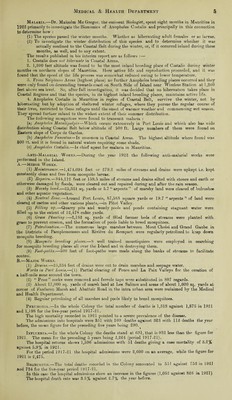
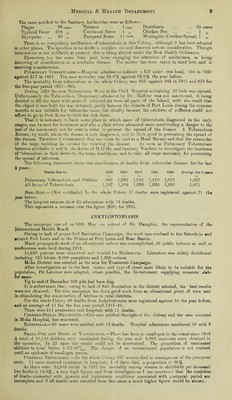
![Dysentery.—Not notifiable.—The mortality for dysentery in the whole Colony was 496 i.e.# ] less than the year before, the quinquennial figure being 730. The hospital admissions show 452 in 1922 against 412 in 1921, and 707 for the five-year period 1917-21. In the dispensaries, however, 1,934 cases were registered against 1/264 the previous year and 1,340 for the past five years. Unfortunately no microscopical examination was made to confirm the nature of disease. Enteric Fever.—In the whole Island 224 cases were registered against 288 in 1921, the highest figures being furnished by Port Louis, Plaines Wilhems and Moka. . 74 cases were admitted for treatment in hospital, 6 less than in previous year. The deaths numbered 20, giving mortality rate of 27% . . The followin'? table shows the seasonal prevalence of the disease in each of the districts :— Total District. Jan. Fsb. Mch. April May June July Aug. Sep. Oct. Nov. Dec. 1922 1921 Port Louis 7 13 i ^ i .—i 19 14 3 3 1 . • • 1 106 34 Pamplemousses... • « • * * 2 ... • • . . . . . . . • . . . . . • • • 2 6 Riv. du Rempart • • • . • . ... 1 • . . . . . • • • 1 1 1 • • • 4 11 Flacq . • • .. 3 ... . • • 1 ... 1 i • • • 5 10 Grand Port 2 . 1 1 1 2 . . , • • • * • • . . • 5 2 14 28 Savanne 3 2 3 1 6 • • • 1 • • . • . 1 » * • i 18 40 Black River .. 1 , . ... • . • . . . ... ... 1 1 Plaines Wilhems 4 7 10 3 1 5 3 3 1 4 5 2 48 1 32 M oka ... 5 4 1 . ... ... 1 Q 3 5 3 26 26 Total ... 14 20 32 26 36 26 18 8 8 11 16 9 224 2 88 - - - - — — — •— •— — — -_ — The figures for the past 10 years are as follows :— 1913 1911 1915 1916 1917 1918 1919 1920 1921 1922 172 234 188 227 244 169 190 168 288 224 As regards Port Louis , the s epidem ic started in February when 7 cases were notified, 13 March, 19 in .4pril, 25 from 1st to 2r‘th May. I investigated every case which was notified as regards water and milk supplies, fly contamina- tiou, carriers, badly performed night soil work, and other possible sources i.e. inspection of aerated water factories, food and markets &e. The difficulties experienced by my Department have been accentuated bv the fact that, Medical Practitioners, in many cases, do not notify the disease until the patient has either recover* d or died, and then only for purposes of having the premises disinfected. 1 have had cases averaging from 40 to 60 days from onset of illness before notification has been received. It will be therefore easily uudersto d that, cases of enteric fever occurring in slums,densely populated, often without proper latrine accomodation, or supervision, and oftener, where latrines are badly constructed, and pails defective and where the night soil service is badly performed, and owing to present system of dealing with “Engrais,” where these discharges are returned to the fields in less than six weeks, so that such late notification and existing conditions prevent the Medical and Health Department from combating the disease in a prompt manner. Investigations, bacteriological and chemical, of water supply showed that the supply from Grand River was grossly polluted and investigations along the whole route convinced me that the causative agent was impure water ; so notices were published through the press (all newpapers) of the danger of drinking unboiled water. The Milk Supplies were carefully investigated and daily visits were made to all milk purveyors and sellers at their homes to trace and report any case of illness. That flies may play an important part I feel confident. This point was brought forward by Drs. Rouget and Celesdns at a recent meeting of the Medical Society. The condition of latrines already mentioned, allows flies to travel from these places and carry the poison to foodstuffs. Dr. Balfour has pointed out in his Heport on Port Louis, that the water from Grand River is grossly polluted and as this is the main source of supply, active steps were taken to ascertain the condition of water from February to May, and both chemical and bacteriological analyses showed that the water was quite unfit and unsafe. Spot Maps all cases of enteric fever relative to water supplies proved this clearly and effectively and further that the water supply before reaching the Municipal Reservoir and direct from pipe showed the greatest incidence. At a meeting of the Medical Society of Mauritius I discussed fully the whole question, its causes, progress, difficulties and asked for further co-operation. The meeting was a happy one and full assistance was promised and they were glad that the Medical Department has consulted and discussed the matter with them : so it augures well for the future. I pointed out the difficulties and almost impossible task laid on the Medical Department by delayed notification. Most of the replies were selfish ones, and too absurd and which could not and would not be tolerated in any other country, namely : (i) Susceptibility of patients, feelings, although the dangers to other members of the population are understood. After full discussion I agree, to suspend the usual daily visit of a Sanitary Inspector. (ii) The system existing in Mauritius of calling in a Medical man once, then waiting 2 or 3 days and if the patient does not get better, another Medical man is called in.](https://iiif.wellcomecollection.org/image/b31484116_0008.jp2/full/800%2C/0/default.jpg)