[Report 1902] / Medical Officer of Health, Rochester City and Port.
- Rochester (Kent, England). City and Port Authority.
- Date:
- 1902
Licence: Attribution 4.0 International (CC BY 4.0)
Credit: [Report 1902] / Medical Officer of Health, Rochester City and Port. Source: Wellcome Collection.
3/22
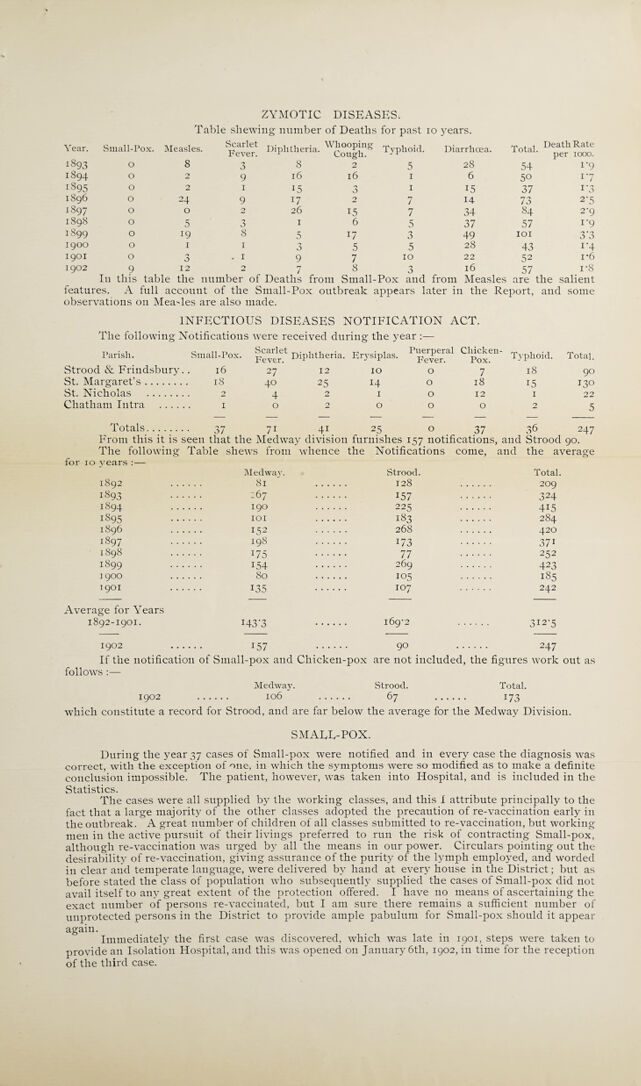
![ZYMOTIC DISEASES. Table shewing number of Deaths for past io years. Year. Small-Pox. Measles. Scarlet Fever. Diphtheria. Typhoid. Diarrhoea. Total Death Rate per 1000. JS93 O 8 'J 3 8 2 5 28 54 1-9 1894 O 2 9 16 16 I 6 50 17 lS95 O 2 1 15 0 I 15 37 t 3 1896 O 24 9 U 2 7 14 73 2'5 1897 O 0 2 26 15 7 34 84 2-9 1898 O 5 3 1 6 5 37 57 i'9 1899 O 19 8 5 17 3 49 IOI 'j • 'j v5 0 1900 O 1 1 3 5 5 28 43 i'4 1901 O 0 0 . 1 9 7 10 22 52 1*6 1902 9 12 2 7 8 O 16 57 1 '8 I11 this table the n umber of Deaths from Small-Pox and from Measles are the salient features. A full account of the Small-Pox outbreak appears later in the Report, and some observations on Measles are also made. INFECTIOUS DISEASES NOTIFICATION ACT. The following Notifications were received during the year :— Parish. Strood & Frindsbury St. Margaret’s.. St. Nicholas . Chatham Iutra .... Small-Pox. Fever * Diphtheria. Erysiplas. Puerperal Fever. Chicken- Pox. Typhoid. Total. 16 27 12 IO O 7 18 90 18 40 25 14 O 18 15 130 2 4 2 1 O 12 I 22 1 020 O O 2 5 37 7i 4i 25 O 37 36 247 Totals. P'rom this it is seen that the Medway division furnishes 157 notifications, and Strood 90. The following Table shews from whence the for 10 years :— Notifications come, and the average Medway. Strood. Total. 1892 . 81 128 209 1^93 . -67 157 324 iS94 . 190 225 415 1S95 . IOI 183 284 1896 . 152 268 ^97 . 198 173 371 1898 . 175 77 252 1899 . 154 423 ] 900 . 80 105 1S5 1901 . 135 107 242 Average for Years 1892-1901. 1437 M M3 N) 3I2-5 1902 . 157 90 247 If the notification of Small-pox and Chicken-pox are not included, the figures work out as follows :— 1902 Medway. 106 Strood. 67 Total. 173 which constitute a record for Strood, and are far below the average for the Medway Division. S MADE-POX. During the year 37 cases of Small-pox were notified and in every case the diagnosis was correct, with the exception of one, in which the symptoms were so modified as to make a definite conclusion impossible. The patient, however, was taken into Hospital, and is included in the Statistics. The cases were all supplied by the working classes, and this I attribute principally to the fact that a large majority of the other classes adopted the precaution of re-vaccination early in the outbreak. A great number of children of all classes submitted to re-vaccination, but working men in the active pursuit of their livings preferred to run the risk of contracting Small-pox, although re-vaccination was urged by all the means in our power. Circulars pointing out the desirability of re-vaccination, giving assurance of the purity of the lymph employed, and worded in clear and temperate language, were delivered by hand at every house in the District; but as before stated the class of population who subsequently supplied the cases of Small-pox did not avail itself to any great extent of the protection offered. I have no means of ascertaining the exact number of persons re-vaccinated, but I am sure there remains a sufficient number of unprotected persons in the District to provide ample pabulum for Small-pox should it appear again. Immediately the first case was discovered, which was late in 1901, steps were taken to provide an Isolation Hospital, and this was opened on January 6th, 1902, in time for the reception of the third case.](https://iiif.wellcomecollection.org/image/b30038649_0003.jp2/full/800%2C/0/default.jpg)