On rest and pain : a course of lectures on the influence of mechanical and physiological rest in the treatment of accidents and surgical diseases, and the diagnostic value of pain / delivered at the Royal College of Surgeons of England in the years 1860, 1861, and 1862 by John Hilton.
- John Hilton
- Date:
- 1879
Licence: Public Domain Mark
Credit: On rest and pain : a course of lectures on the influence of mechanical and physiological rest in the treatment of accidents and surgical diseases, and the diagnostic value of pain / delivered at the Royal College of Surgeons of England in the years 1860, 1861, and 1862 by John Hilton. Source: Wellcome Collection.
Provider: This material has been provided by the Harvey Cushing/John Hay Whitney Medical Library at Yale University, through the Medical Heritage Library. The original may be consulted at the Harvey Cushing/John Hay Whitney Medical Library at Yale University.
284/320 page 270
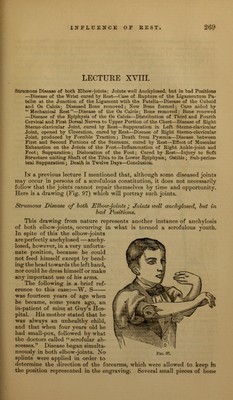
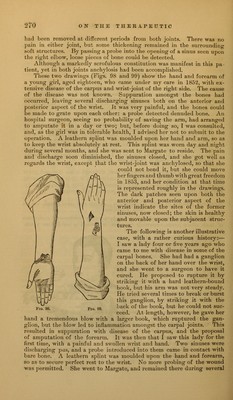
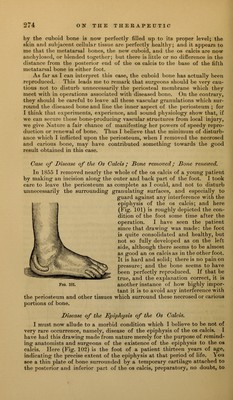
![had been removed at different periods from both joints. There was no ]>;:in in either joint, but some thickening remained in the surrounding soft structures. By passing a probe into the opening of a sinus seen upon the right elbow, loose pieces of bone could be detected. Although a markedly scrofulous constitution was manifest in this pa- tient, yet in both joints anchylosis had been accomplished. These two drawings (Figs. 98 and 99) show the hand and forearm of a young girl, aged eighteen, who came under my care in 1852, with ex- tensive disease of the carpus and wrist-joint of the right side. The cause of the disease was not known. Suppuration amongst the bones had occurred, leaving several discharging sinuses both on the anterior and posterior aspect of the wrist. It was very painful, and the bones could be made to grate upon each other: a probe detected denuded bone. An hospital surgeon, seeing no probability of saving the arm, had arranged to amputate it in a day or two; but, before doing so, I was consulted, and, as the girl was in tolerable health, I advised her not to submit to the operation. A leathern splint was moulded upon her hand and arm, so as to keep the wrist absolutely at rest. This splint was worn day and night during several months, and she was sent to Margate to reside. The pain and discharge soon diminished, the sinuses closed, and she got well as regards the wrist, except that the wrist-joint was anchylosed, so that she could not bend it, but she could move her fingers and thumb with great freedom in 1853, and her condition at that time is represented roughly in the drawings. The dark patches seen upon both the anterior and posterior aspect of the wrist indicate the sites of the former sinuses, now closed; the skin is healthy and movable upon the subjacent struc- tures. The following is another illustrative case, with a rather curious history:— I saw a lady four or five years ago who came to me with disease in some of the carpal bones. She had had a ganglion on the back of her hand over the wrist, and she went to a surgeon to have it cured. He proposed to rupture it by striking it with a hard leathern-bound book, but his arm was not very steady. He tried several times to break or burst this ganglion, by striking it with the back of the book, but he could not suc- ceed. At length, however, he gave her hand a tremendous blow with a larger book, which ruptured the gan- glion, but the blow led to inflammation amongst the carpal joints. This resulted in suppuration with disease of the carpus, and the proposal of amputation of the forearm. It was then that I saw this lady for the first time, with a painful and swollen wrist and hand. Two sinuses were discharging pas, and a probe introduced into them came in contact with bare bone. A leathern splint was moulded upon the hand and forearm, so as to secure perfect rest to the wrist. No more probing of the wound was permitted. She went to Margate, and remained there during several Fio. 98. Fig. 99.](https://iiif.wellcomecollection.org/image/b2102005x_0284.jp2/full/800%2C/0/default.jpg)