On rest and pain : a course of lectures on the influence of mechanical and physiological rest in the treatment of accidents and surgical diseases, and the diagnostic value of pain / delivered at the Royal College of Surgeons of England in the years 1860, 1861, and 1862 by John Hilton.
- John Hilton
- Date:
- 1879
Licence: Public Domain Mark
Credit: On rest and pain : a course of lectures on the influence of mechanical and physiological rest in the treatment of accidents and surgical diseases, and the diagnostic value of pain / delivered at the Royal College of Surgeons of England in the years 1860, 1861, and 1862 by John Hilton. Source: Wellcome Collection.
Provider: This material has been provided by the Harvey Cushing/John Hay Whitney Medical Library at Yale University, through the Medical Heritage Library. The original may be consulted at the Harvey Cushing/John Hay Whitney Medical Library at Yale University.
30/320
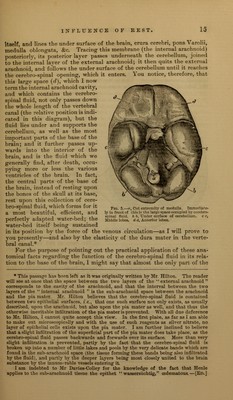
![base of the brain which fits in close coaptation with the bones of the skull is the inferior part of the anterior lobe of the cerebrum, where it rests upon the orbital plates of the frontal bones. So accurate is this coapta- tion, that if you were to make a cast of the interior of this portion of the skull, and compare the model from it with the under surface of that part of the brain which naturally occupies this position, you would find them in exact correspondence. This is not the case with the other portions of the base of the brain. If you examine these two models f which I have placed before you, you will find that one of them is an exact out- line and configuration of the va- rious parts which form the base of the brain; the other model is simply a wax cast of the interior of the same skull, deprived of the brain. Now, if the base of the brain rested upon the base of the skull, the wax model which is taken from the interior of the skull ought to give a cast exactly corresponding to the base of the brain. But we see that this is not so, and the great difference marks the extent of the interval occupied by the cerebro-spinal fluid. We have here a complete demonstra- tion that there is not a coaptation or exact fitting between the under surface, or base of the brain, and those bones which form the base of the skull. This sustains the opinion that the two middle thirds of the base of the brain do not rest upon the bones, indeed do not touch the bones at all, but rest upon this collection of cerebro-spinal fluid, which I have ventured to call the perfect water-bed of the brain. Hence a person may fracture the base of the skull, and yet show no evidence of injury to the brain itself; a fact which every observing surgeon knows to be true. I well remember a man walking into Guy's Hospital, sitting upon his bedside, undressing himself, and lying down composedly in his bed: this patient, on his ad- mission, had bleeding from both his ears, and subsequently died from the injury to his head, it being shown at the post-mortem examination that he had a very severe fracture of the base of the skull. Yet this man walked into the hospital, and showed no manifestation of loss of power or sensation in his legs, and no evidence of any encroachment upon those parts of the brain which form its base. Some time since I was requested to see a gentleman in the country, who, coming home from hunting, was thrown from his horse, and got his foot entangled in the stirrup. In his fall he struck the back part of his head. After a time his horse was stopped; he disentangled his foot from the stirrup, and expressing himself somewhat confused, mounted his Fig. 6.—Drawing of nape of skull, introduced to show the want of correspondence between certain parts of the base of the skull and of the brain. * The two models here referred to are in the museum of Guy's Hospital, of them, showing the base of the brain, is represented in Fig. 5.—[Ed.] One](https://iiif.wellcomecollection.org/image/b2102005x_0030.jp2/full/800%2C/0/default.jpg)



 No text description is available for this image
 No text description is available for this image
 No text description is available for this image