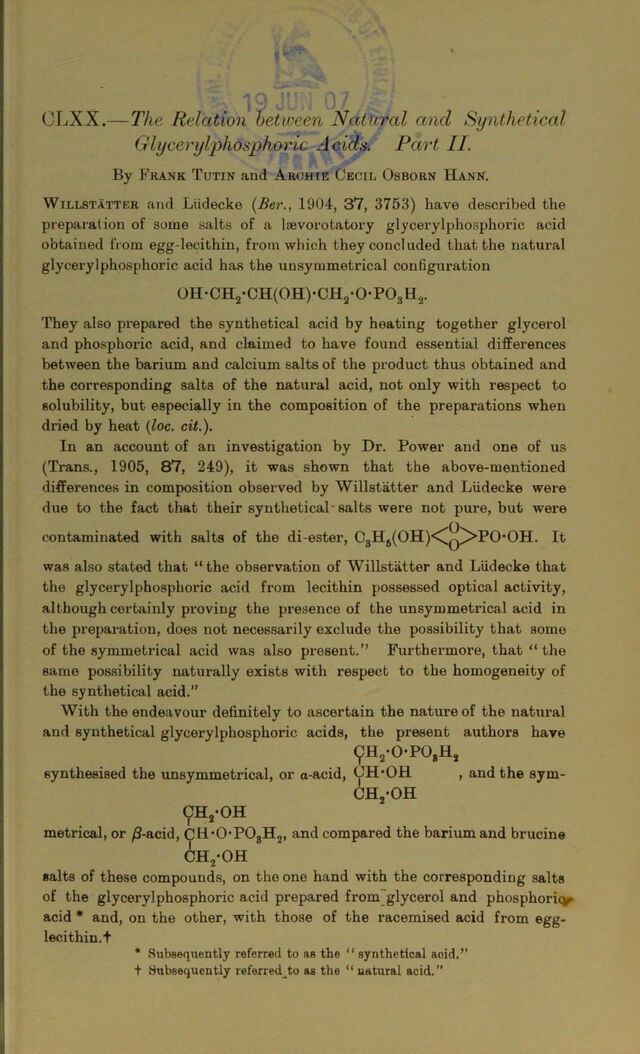
The relation between natural and synthetical glycerylphosphoric acids. Pt. II / by Frank Tutin and A.C.O. Hann.
- Tutin, Frank.
- Date:
- 1906
Licence: Attribution 4.0 International (CC BY 4.0)
Credit: The relation between natural and synthetical glycerylphosphoric acids. Pt. II / by Frank Tutin and A.C.O. Hann. Source: Wellcome Collection.
Provider: This material has been provided by The Royal College of Surgeons of England. The original may be consulted at The Royal College of Surgeons of England.
4/14 page 1750
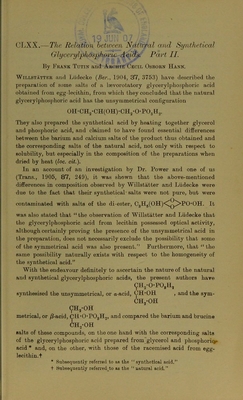
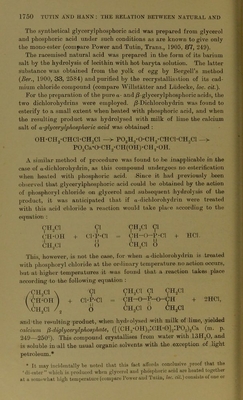
![The synthetical glycerylphosphoric acid was prepared from glycerol and phosphoric acid under such conditions as are known to give only the mono-ester (compare Power and Tutin, Trans., 1905, 87, 249). The racemised natural acid was prepared in the form of its barium salt by the hydrolysis of lecithin with hot baryta solution. The latter substance was obtained from the yolk of egg by Bergell’s method (Ber., 1900, 33, 2584) and purified by the recrystallisntion of its cad- mium chloride compound (compare Willstatter and Liidecke, loc. cit.). For the preparation of the pure a- and /J-glycerylphosphoric acids, the two dichlorohydrins were employed. /2-Dichlorohydriu was found to esterify to a small extent when heated with phosphoric acid, and when the resulting product was hydrolysed with milk of lime the calcium salt of a -glycerylphosphoric acid was obtained : 0H-CH2*CHC1-CH2C1 —> P08H2-0-CH2-CHC1-CHoC1 -> P03Ca-0*CH2-0H(0H)-CH2-0H. C A. similar method of procedure was found to be inapplicable in the case of a-dichlorohydrin, as this compound undergoes no esterification when healed with phosphoric acid. Since it had previously been observed that glycerylphosphoric acid could be obtained by the action of phosphoryl chloride on glycerol and subsequent hydrolysis of the product, it was anticipated that if a-dichlorohydrin were treated with this acid chloride a reaction would take place according to the equation : CII2C1 Cl CH2C1 Cl CH-OH + Cl-P-Cl = CH-O-P-Cl + HC1. CH2C1 O CH2C1 O This, however, is not the case, for when a-dichlorohydrin is treated with phosphoryl chloride at the ordinary temperature no action occurs, but at higher temperatures it was found that a reaction takes place according to the following equation : /CH2C1 \ 91 CH2C1 Cl CH2C1 ( CH-OH ) + Cl-P-Cl = CH-0-P-0-<|!H + 2HCI, \CH2C1 /2 0 CH2C1 O CH2C1 and the resulting product, when hydrolysed with milk of lime, yielded calcium fi-diglycerylphosphate, ([(CH2*0H)2.0H,G]2.P02)2Ca (m. p. 249—250°). This compound crystallises from water with 13H20, and is soluble in all the usual organic solvents with the exception of light petroleum.* * It may incidentally he noted that this fact affords conclusive proof that the ‘ di-ester” which is produced when glycerol and phosphoric acid are heated together at a somewhat high temperature (compare Power and Tutin, loc. cil.) consists of one 01](https://iiif.wellcomecollection.org/image/b22425433_0006.jp2/full/800%2C/0/default.jpg)




 No text description is available for this image
 No text description is available for this image
 No text description is available for this image