The relation between natural and synthetical glycerylphosphoric acids. Pt. II / by Frank Tutin and A.C.O. Hann.
- Tutin, Frank.
- Date:
- 1906
Licence: Attribution 4.0 International (CC BY 4.0)
Credit: The relation between natural and synthetical glycerylphosphoric acids. Pt. II / by Frank Tutin and A.C.O. Hann. Source: Wellcome Collection.
Provider: This material has been provided by The Royal College of Surgeons of England. The original may be consulted at The Royal College of Surgeons of England.
8/14 page 1754
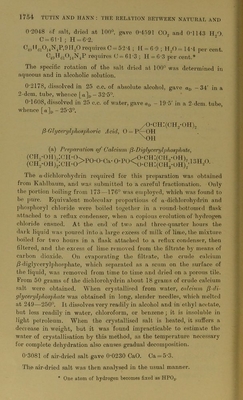
![C = GI • 1 ; H = 6-2. C4c,II(U0i4N4P,9Ir20 requires C = 52-4 ; It = 6• 0 ; ll.,0=14-4 per cent. 0-2048 of salt, dried at 100°, gave 0-4591 CO., and 0-1143 Uo0. requires 0 = 61-3 ; II = 6 3 per cent.* The specific rotation of the salt dried at 100° was determined in aqueous and in alcoholic solution. 0-2178, dissolved in 25 c.c. of absolute alcohol, gave aD -34' in a 2-dcm. tube, whence [a],)- 32-50. 0-1608, dissolved in 25 c.c. of water, gave aD - 19-5' in a 2-dcm. tube, whence [a]D - 25-3°. from Kahlbaum, and was submitted to a careful fractionation. Only the portion boiling from 173—176° was employed, which was found to phosphoryl chloride were boiled together in a round-bottomed flask attached to a reflux condenser, when a copious evolution of hydrogen chloride ensued. At the end of two and three-quarter hours the boiled for two hours in a flask attached to a reflux condenser, then filtered, and the excess of lime removed from the filtrate by means of carbon dioxide. On evaporating the filtiate, the crude calcium ^-diglycerylphosphate, which separated as a scum on the surface of the liquid, was removed from time to time and dried on a porous tile. From 50 grams of the dichlorohydrin about 18 grams of crude calcium salt were obtained. When crystallised from water, calcium (3-di- glycerylpliosphale was obtained in long, slender needles, which melted at 249—250°. It dissolves very readily7 in alcohol and in ethyl acetate, but less readily7 in water, chloroform, or benzene ; it is insoluble in light petroleum. When the crystallised salt is heated, it suffers a deciease in weight, but it was found impracticable to estimate the water of crystallisation by this method, as the temperature necessary for complete dehydration also causes gi'adual decomposition. 03081 of air-dried salt gave 0-0230 CaO. Ca = 5-3. The air-dried salt was then analysed in the usual manner. (3-Glycerylphosphoric Acid, 0 = P (a) Preparation of Calcium (3-Dujlycerylphosphate, The a-diehlorohydrin required for this preparation was obtained be pure. Equivalent molecular proportions of a-diclilorohyrdrin and dark liquid was poured into a large excess of milk of lime, the mixture * One atom of hydrogen becomes fixed as HPOs.](https://iiif.wellcomecollection.org/image/b22425433_0010.jp2/full/800%2C/0/default.jpg)