Cadmus: or, a treatise on the elements of written language, illustrating, by a philosophical division of speech, the power of each character, thereby mutually fixing the orthography and orthoepy. With an essay on the mode of teaching the surd or deaf, and consequently dumb, to speak / by William Thornton.
- William Thornton
- Date:
- 1793
Licence: Public Domain Mark
Credit: Cadmus: or, a treatise on the elements of written language, illustrating, by a philosophical division of speech, the power of each character, thereby mutually fixing the orthography and orthoepy. With an essay on the mode of teaching the surd or deaf, and consequently dumb, to speak / by William Thornton. Source: Wellcome Collection.
40/114 page 38
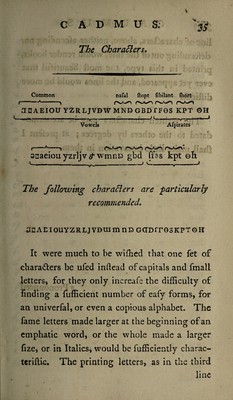
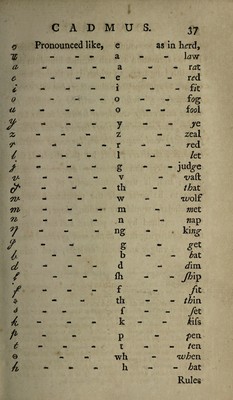
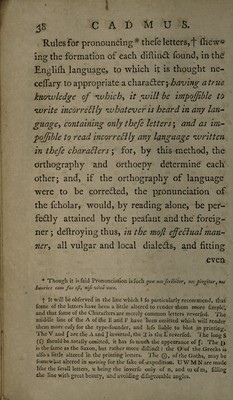
![\ 38 CADMUS. Rules for pronouncing* thefe letters,']' fhew« ing the formation of each diftind found, in the Englifh language, to which it is thought ne- celfary to appropriate a charader ; having a true knowledge of which, it will be impoJJible tb write incorreCtly whatever is heard in any lan- guage, containing only thefe letters; and as im- poffible to read incorrectly any language written in thefe characters; for, by this method, the orthography and orthoepy determine each other; and, if the orthography of language were to be correded, the pronunciation of the fcholar, would, by reading alone, be per- fedly attained by the peafant and the foreig¬ ner ; deftroying thus, in the mojl effectual man- nery all vulgar and local dialeds, and fitting even * Though it isfaid Pronunciation isfuch qua nec fcribitur, necpingitur, nec baurire cam fas eft, nift viva voce. f It will be obferved in the line which I fo particularly recommend, that fome of the letters have been a little altered to render them more fimple'V and that fome of the Characters are merely common letters reverfed. The middle line of the A of the E and F have been omitted which will render them more eafy for the type-founder, and lefs liable to blot in printing. The V and f are the A and J inverted, the J is the E reverfed. The long S (f) ihould be totally omitted, it has fo much the appearance of f. The £) is the fame as the Saxon, but rather more difbintSl : the 0 of the Greeks is alfo a little altered in the printing letters. The ©, of the Goths, maybe iomewbat altered in writing for the fake of expedition. U WM N are made like the fmall letters, u being the inverfe only of n, and ui of m, filling the line with great beauty, and avoiding difagreeablc angles.](https://iiif.wellcomecollection.org/image/b30794353_0040.jp2/full/800%2C/0/default.jpg)