[Report 1904] / Medical Officer of Health, Salop / Shropshire County Council.
- Shropshire Council
- Date:
- 1904
Licence: Attribution 4.0 International (CC BY 4.0)
Credit: [Report 1904] / Medical Officer of Health, Salop / Shropshire County Council. Source: Wellcome Collection.
92/100 (page 72)
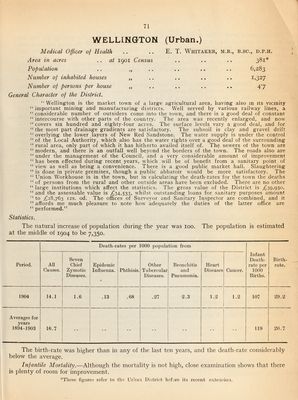
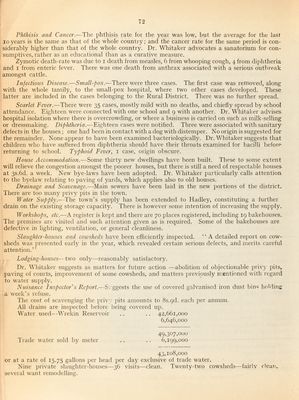
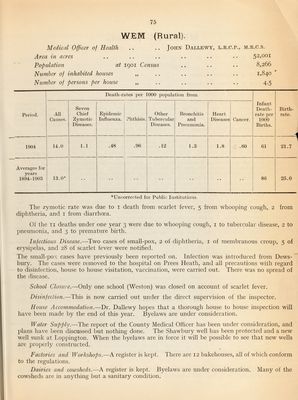
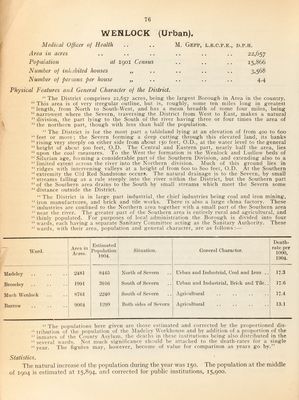
![Phthisis and Cancer.—The phthisis rate for the year was low, but the average for the last 10 years is the same as that of the whole country; and the cancer rate for the same period is con¬ siderably higher than that of the whole country. Dr. Whitaker advocates a sanatorium for con¬ sumptives, rather as an educational than as a curative measure. Zymotic death-rate w'as due to i death from measles, 6 from whooping cough, 4 from diphtheria and I from enteric fever. There was one death from anthrax associated with a serious outbreak amongst cattle. Infections Disease.—Small-pox.—There were three cases. The first case was removed, along with the whole lamily, to the small-pox hospital, where two other cases developed. These latter are included in the cases belonging to the Rural District. There was no further spread. Scarlet Fever.—There were 35 cases, mostly mild with no deaths, and chiefly spread by school attendance. Eighteen were connected with one school and g with another. Dr. Whitaker advises hospital isolation where there is overcrowding, or where a business is carried on such as milk-selling or dressmaking. Diphtheria.—Eighteen cases were notified. Three were associated with sanitary defects in the houses ; one had been in contact with a dog with distemper. No origin is suggested for the remainder. None appear to have been examined bacteriologically. Dr. Whitaker suggests that children who have suffered from diphtheria should have their throats examined for bacilli before returning to school. Typhoid Fever, i case, origin obscure. House Accommodation.—Some thirty new dwellings have been built. These to some extent will relieve the congestion amongst the poorer houses, but there is still a need of respectable houses at 3s.6d. a week. New bye-laws have been adopted. Dr. Whitaker particularly calls attention to the byelaw relating to paving of yai'ds, which applies also to old houses. Drainage and Scavenage.—Main sewers have been laid in the new portions of the district. There are too many privy pits in the town. Water Supply.—-The town’s supply has been extended to Hadley, constituting a further drain on the existing storage capacity. There is however some intention of increasing the supply. Workshops, etc.—A register is kept and there are 70 places registered, including 19 bakehouses. The premises are visited and such attention given as is required. Some of the bakehouses are defective in lighting, ventilation, or general cleanliness. Slaughter-houses and cowsheds have been efficiently inspected. ‘ ‘ A detailed report on cow¬ sheds was jiresented early in the year, which revealed certain serious defects, and merits careful attention.” Lodging-houses—two only—reasonabl}^ satisfactory. Dr. Whitaker suggests as matters for future action —abolition of objectionable privy pits,, paving of courts, improvement of some cowsheds, and matters previously mentioned with regard to water sui)ply. Nuisance InspectoFs Report.—Suggests the use of covered galvanised iron dust bins holding I a week’s refuse. The cost of scavenging the priv;' pits amounts to 8s.gd. each per annum. All drains are inspected before being covered up. Water used—-Wrekin Reservoir .. . . 42,661,000 6,646,000 49,307,000 Trade water sold by meter .. .. 6,igg,ooo 43,108,000 or at a rate of 15.75 gallons per head per day exclusive of trade water. Nine ])rivate slaughter-houses—36 visits—clean. Twenty-two cowsheds—fairh' cleaii, several want remodelling.](https://iiif.wellcomecollection.org/image/b30086450_0092.jp2/full/800%2C/0/default.jpg)