[Report 1904] / Medical Officer of Health, Salop / Shropshire County Council.
- Shropshire Council
- Date:
- 1904
Licence: Attribution 4.0 International (CC BY 4.0)
Credit: [Report 1904] / Medical Officer of Health, Salop / Shropshire County Council. Source: Wellcome Collection.
99/100 (page 79)
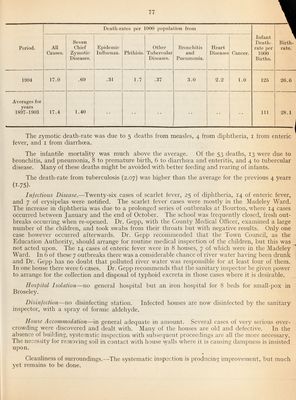
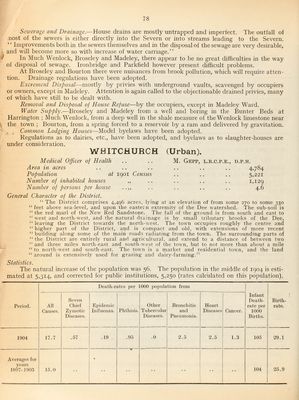
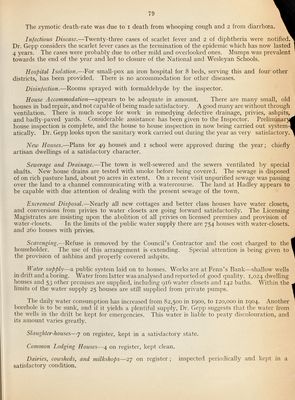
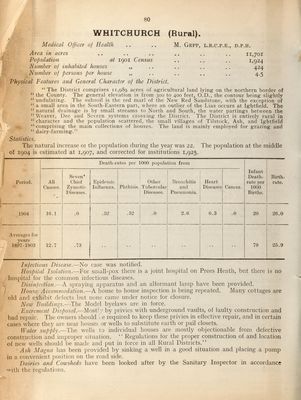
![The zymotic death-rate was due to i death from whooping cough and 2 from diarrhoea Infectious Disease.—Twenty-three cases of scarlet fever and 2 of diphtheria were notified. Dr. Gepp considers the scarlet fever cases as the termination of the epidemic which has now 4 years. The cases were probably due to other mild and overlooked ones. Mumps was prevalent towards the end of the year and led to closure of the National and Wesleyan Schools. 1 )tified.^ lasted Hospital Isolation.—For small-pox an iron hospital for 8 beds, serving this and four other districts, has been provided. There is no accommodation for other diseases. Disinfection.—Rooms sprayed with formaldehyde by the inspector. House .Accommodation—appears to be adequate in amount. There are many small, old houses in bad repair, and not capable of being macle satisfactory. A good many are without through ventilation. There is much scope for work in remedying defective drainage, privies, ashpits, and badly-paved yards. Considerable assistance has been given to the Inspector. Preliminar5fl house inspection is com})lete, and the house to house inspection in now being carried out system-] atically. Dr. Gepp looks upon the sanitary work carried out during the year as very satisfactory. New Houses.—Plans for 49 houses and i school were approved during the year; chiefly artisan dwellings of a satisfactory character. Sewerage and Drainage.—The town is well-sewered and the sewers ventilated by special shafts. New house drains are tested with smoke before being covered. The sewage is disposed of on rich pasture land, about 70 acres in extent. On a recent visit unpurified sewage was passing over the land to a channel communicating with a watercourse. The land at Hadley appears to be capable with due attention of dealing with the present sewage of the town. Excrement Disposal.—Nearly all new cottages and better class houses have water closets, and conversions from privies to water closets are going forward satisfactorily. The Licensing Magistrates are insisting upon the abolition of all privies on licensed premises and provision of water-closets. In the limits of the public water supply there are 754 houses with water-closets, and 260 houses with privies. Scavenging.—Refuse is removed by the Council’s Contractor and the cost charged to the householder. The use of this arrangement is extending. Special attention is being given to the provision of ashbins and ]:)roperly covered ashpits. Water supply—a public system laid on to houses. Works are at Fenn’s Bank—shallow wells in drift and a boring. Water from latter was analysed and reported of good quality. 1,024 dwelling houses and 53 other premises are supplied, including gi6 water closets and 142 baths. Within the limits of the water supply 25 houses are still supplied from pri\'ate pumps. The daily water consumption has increased from 82,500 in igoo, to 120,000 in 1904. Another borehole is to be sunk, and if it yields a plentiful supply, Dr. Gepp suggests that the water from the wells in the drift be kept for emergencies. This water is liable to peaty discolouration, and its amount varies greatly. Slaughter-houses—7 on register, kept in a satisfactory state. Common Lodging Houses—4 on register, kept clean. Dairies, cowsheds, and milkshops—27 on register ; inspected periodically and kept in a satisfactory condition.](https://iiif.wellcomecollection.org/image/b30086450_0099.jp2/full/800%2C/0/default.jpg)