Difficult labour : a guide to its management for students and practitioners / by G. Ernest Herman.
- Herman G. Ernest (George Ernest), 1849-1914.
- Date:
- 1901
Licence: In copyright
Credit: Difficult labour : a guide to its management for students and practitioners / by G. Ernest Herman. Source: Wellcome Collection.
Provider: This material has been provided by the Royal College of Physicians of Edinburgh. The original may be consulted at the Royal College of Physicians of Edinburgh.
28/488
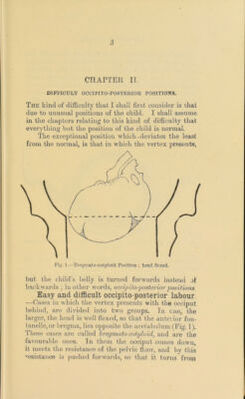
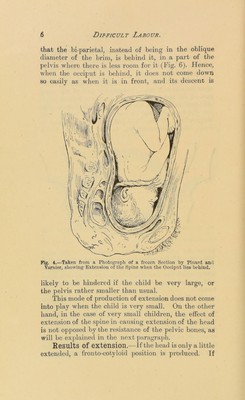
![op})Osite tlie sacro iliac synchondrosis to under the pubic arch. Tlius tlio abnormal position, with the occiput behind, is changed into a normal one, with the occiput in front (Fig. 2). When this rotation has taken place the labour ends just as if the occiput had been in front fiom the beginning ; and no assistance is required except what may be called for by reasons other than the position of the child. Fortunately, Fig. 2. —Showing the Rotation that should take Place in Occipito-posterior Positions. the majority of cases of vertex presentation with the occiput behind, end in this way. In the other group of cases the head is not well flexed, and then, instead of the anterior fontanelle being opposite the acetabulum, the fronbal eminence is opposed to it. These cases are called fronto-cotyloid (Fig. 3). Why flexion is imperfect in occipito-posterior positions.—Extension of the head in occipito-posterior presentations comes about in two ways; first, {a) because the axis of the uterus and of the pelvic brim is concave ])ehind ; second, (6) because the greatest diameter of the head is l)ehind its centre.](https://iiif.wellcomecollection.org/image/b21719950_0028.jp2/full/800%2C/0/default.jpg)