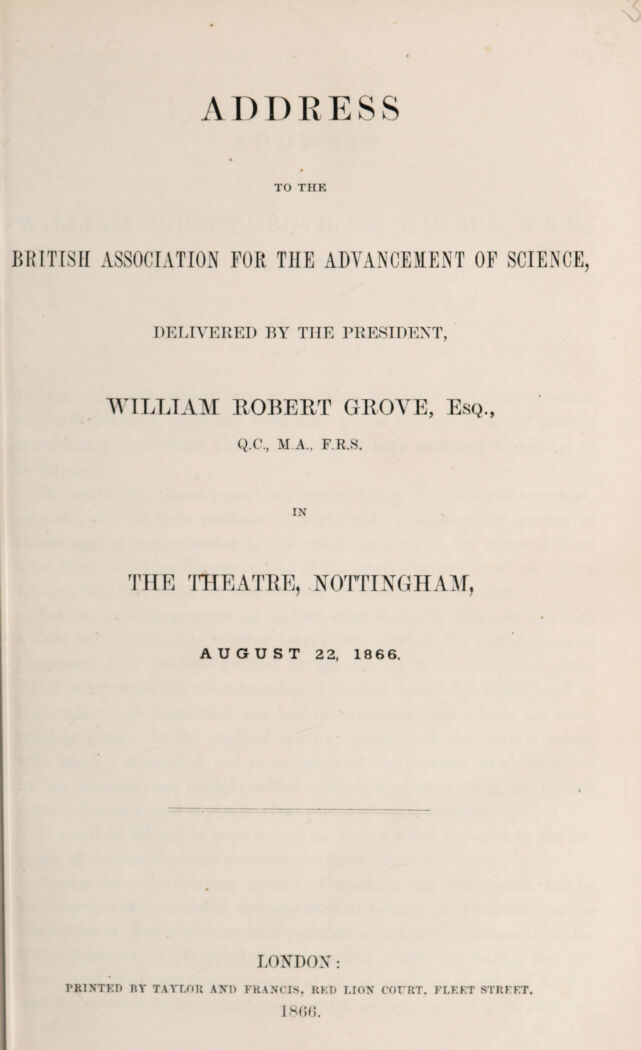
Address to the British Association for the Advancement of Science / delivered by the President, William Robert Grove ... in the Theatre, Nottingham, August 22, 1866.
- William Robert Grove
- Date:
- 1866
Licence: Public Domain Mark
Credit: Address to the British Association for the Advancement of Science / delivered by the President, William Robert Grove ... in the Theatre, Nottingham, August 22, 1866. Source: Wellcome Collection.
7/40 page 5
![One word will give you the key to what I am about to discourse on ; that word is continuityj no new word, and used in no new sense, but perhaps applied more generally than it has hitherto been. We shall sec, unless I am much mistaken, that the development of observational, experimental, and even deductive knowledge is either attained by steps so extremely small as to form really a continuous ascent; or, when distinct results apparently separate from any coordinate phenomena have been attained, that then, by the suhsecpient progress of science, intermediate links have been discovered uniting the apparently segregated instances with other more familiar phenomena. Thus the more we investigate, the more we find that in existing phe¬ nomena graduation from the like to the seemingly unlike prevails, and in the changes which take place in time, gradual progress is, and apparently must be, the course of nature. Let me now endeavour to apply this view to the recent progress of some of the more prominent branches of science. In Astronomy, from the time when the earth was considered a flat plain hounded by a flat ocean,—when the sun, moon, and stars were regarded as lanterns to illuminate this plain,—each successive discovery has brought with it similitudes and analogies between this earth and many of the objects of the universe with which our senses, aided by instruments, have made us acquainted. I pass, of course, over those discoveries which have established the Copernican systemas applied to our sun, itsattendantp]ancts,andtheirsatellitcs. The proofs, however, that gra\dtation is not confined to ouT solar system, hut pervades the universe, have received many confirmations by the labours of Members of this Association; I may name those who have held the office of President, Lord Kosse, Lord Wrottesley, and Sir J. Herschel, the two latter having devoted special attention to the orbits of double stars, the former to those probably more recent systems called nebulae. Double stars seem to he orbs analogous to our own sun and revolving round their common centre of gravity in a conic-section curve, as do the planets with which we are more intimately acquainted; hut the nebulae present more difficulty, and some doubt has been expressed whether gravitation, such as we consider it, acts with those bodies (at least those exhibiting a spiral form) as it does with us; possibly some other modifying influence may exist, our present ignorance of which gives rise to the apparent difficulty. There is, however, another class of observations quite recent in its importance, and which has formed a special subject of contnbution to the Keports and Transactions of this Association ; I allude to those on ^Meteorites, at which our lamented iMember, and to many of us our valued friend, Prof. Baden Powell assiduously laboured,](https://iiif.wellcomecollection.org/image/b30567828_0007.jp2/full/800%2C/0/default.jpg)