The water supply of Oxfordshire, with records of sinkings and borings / by R.H. Tiddeman ... with contributions on rainfall by Hugh Robert Mill ... Pub. by order of the lords commissioners of His Majesty's Treasury.
- Tiddeman, R. H. (Richard Hill)
- Date:
- 1910
Licence: In copyright
Credit: The water supply of Oxfordshire, with records of sinkings and borings / by R.H. Tiddeman ... with contributions on rainfall by Hugh Robert Mill ... Pub. by order of the lords commissioners of His Majesty's Treasury. Source: Wellcome Collection.
7/118
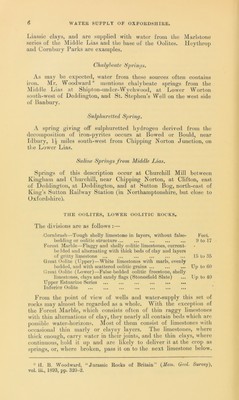
![OF OXFORDSHIRE. INTKODCCTION. it seems appropriate, in entering on a description of the ^\ ater Supply of Oxfordshire, to fpiote a remark made by a ^ great Geologist for many years connected with the University as Professor, and of world-wide renown as an authority on water- supply, the late Sir Joseph Prestwich :—“ It is estimated, that in these latitudes, and in a country where the surface presents the ordinary variations of permeable and impermeable strata, about one-third of the rainfall is lost by evaporation, another third flows at once from off the surface into the rivers, while the remaining third passes underground to feed and maintain the underground s])rings. These proportions necessarily vary according to the nature of the ground—a large quantity running off at once into the rivers wherever the strata are argillaceous or hard and compact. In river-basins so conditioned the rivers are consequently more torrential, overflowing in winter, but often dry in summer. Where on the contrary the strata consist of permeable sandy and freestone strata, or of fissured limestones, a large proportion of the rainfall passes underground and is there stored to be gradually returned to the surface in the form of perennial springs ^ * The river-delivery, therefore, represents in fact both the rainfall at once draining into them from off the surface, less the portion lost by evaporation, and part of that which, though it passes underground, is finally, through the agency of springs, discharged into the rivers.”* In the Thames river-basin, of which the area of Oxfordshire forms an important part, we have several broad belts of impermeable strata which tend to promote the “ torrential ” action (though this is much modified by the artificial control of the stream as a navigable river) and also abundant fissured limestones, sandstones, and surface-gravels, which use their influence towards “ storage.” Kain, as it falls from the clouds, is practically pure, but in the lower regions of the atmosphere it picks up some carbonic acid, and still more on the surface of the soil from the decay of vegetable matter. Equipped with this, it is ready to dissolve carbonate of lime, which enters largely into the composition of many rocks in this district, and carbonate of magnesia. Sulphate of lime it derives from the Oxford and Kimmeridge Clays, which contain](https://iiif.wellcomecollection.org/image/b28127262_0007.jp2/full/800%2C/0/default.jpg)