Intestinal obstruction; its varieties : with their pathology, diagnosis, and treatment.
- Sir Frederick Treves, 1st Baronet
- Date:
- 1899
Licence: Public Domain Mark
Credit: Intestinal obstruction; its varieties : with their pathology, diagnosis, and treatment. Source: Wellcome Collection.
Provider: This material has been provided by the Augustus C. Long Health Sciences Library at Columbia University and Columbia University Libraries/Information Services, through the Medical Heritage Library. The original may be consulted at the the Augustus C. Long Health Sciences Library at Columbia University and Columbia University.
65/586 page 49
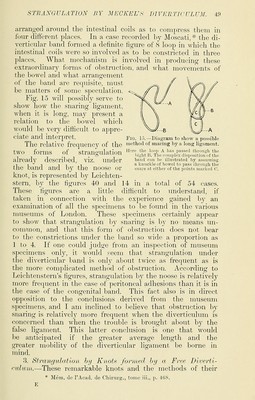
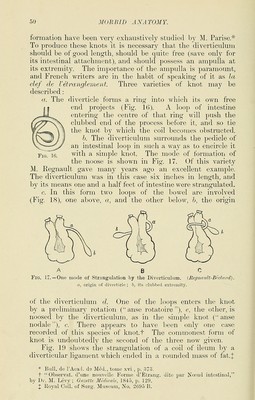
![comp] band can be illustrated'by assuming a knuckle of bowel to pass through tlie snare at either of the points marked C. arranged around the intestinal coils as to compress them in four different places. In a case recorded by Moscati, ^ the di- verticular band formed a definite figure of 8 loop in which the intestinal coils were so involved as to be constricted in three places. What mechanism is involved in producing these extraordinary forms of obstruction, and what movements of the bowel and what arrangement of the band are requisite, must be matters of some speculation. Fig. 15 will possibly serve to show how the snaring ligament, Avhen it is long, may present a II ^ Mc relation to the bowel which would be very difficult to appro- ^-^s^^-.-B \J/---f^ Ciate and interpret. Fig. 15.—Diagram to show a possible The relative frequency of the method of snaring by a long ligament. two fnrmc; ni' Qtvanrmlntinn Here the loop A has passed through the two lorms or Stl angulation WghtB. The complex disposition of the already described, viz. under the band and by the noose or knot, is represented by Leichten- stern, by the figures 40 and 14 in a total of 54 cases. These figures are a little difficult to understand, if taken in connection with the experience gained by an examination of all the specimens to be found in the various museums of London. These specimens certainly appear to show that strangulation by snaring is by no means un- common, and that this form of obstruction does not bear to the constrictions under the band so wide a proportion as 1 to 4. If one could judge from an inspection of museum specimens only, it would seem that strangulation under the diverticular band is only about twice as frequent as is the more complicated method of obstruction. According to Leichtenstern's figures, strangulation by the noose is relatively more frequent in the case of peritoneal adhesions than it is in the case of the congenital band. This fact also is in direct opposition to the conclusions derived from the museum s^^ecimens, and I am inclined to believe that obstruction by snaring is relatively more frequent when the diverticulum is concerned than when the trouble is brought about by the false ligament. This latter conclusion is one that would be anticipated if the greater average length and the greater mobility of the diverticular ligament be borne in mind. 3. Strangulation by Knots formed hy a Free Diverti- culum.—These remarkable knots and the methods of their * Mem. de I'Acad. de Chirurg., tome iii., p. 468.](https://iiif.wellcomecollection.org/image/b21205516_0065.jp2/full/800%2C/0/default.jpg)