Intestinal obstruction; its varieties : with their pathology, diagnosis, and treatment.
- Sir Frederick Treves, 1st Baronet
- Date:
- 1899
Licence: Public Domain Mark
Credit: Intestinal obstruction; its varieties : with their pathology, diagnosis, and treatment. Source: Wellcome Collection.
Provider: This material has been provided by the Augustus C. Long Health Sciences Library at Columbia University and Columbia University Libraries/Information Services, through the Medical Heritage Library. The original may be consulted at the the Augustus C. Long Health Sciences Library at Columbia University and Columbia University.
86/586 page 70
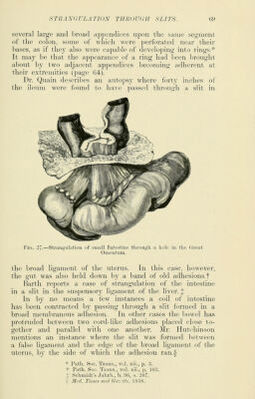
![I have operated uj^on a case in which repeated attacks of intestinal obstruction were due to the snaring of a loop of small intestine through a slit in the sustentaculum lienis. That fold of peritoneum was in this instance represented by two substantial parallel cords.^ In some cases rings and slits have been formed between intestinal loops which have become matted together, and through these apertures a non-adherent coil has passed and become constricted. In one case, briefly mentioned by Sir Astley Cooper, it was found that two folds of intestine had adhered at one point only (as ma}^ be represented by bringing the points of the thumb and finger in contact); through the noose thus formed another fold of intestine was passed and had become strangulated. t The occasional gaps and slits which may be formed between adherent intestines, and the viscus or parietes to w^hich they are attached, may serve as holes through which a coil of bowel may pass and be constricted. The Portion of Intestine Involved and the Mechanism of the Obstruction.—In the form of intestinal obstruction now under consideration, although many very different methods are concerned in the production of that obstruc- tion, tli,e part of the alimentary tube involved is, with scarcely an exception, the same, viz. the small intestine. A case has already been incidentally alluded to where a part of the ascending colon was found compressed beneath an adherent vermiform appendix (page 62), and another where a loo]3 of the sigmoid flexure w^as strangulated through a rent in the mesentery (page 68). Instances may be given where a part of the colon has been obstructed beneath a tightly drawn mesentery (Duchaussoy), together with a few other observations of the same character. So rare^ however, is it for any part of the colon to be involved in the present variety of intestinal obstruction that, so far as the general bearings of the whole subject are concerned, the few reported cases may be regarded ahnost as pathological curiosities. If it be borne in mind that the hernia-like strangulation of the bowel requires that the gut to be involved should be quite free and movable, and that it should be capable also of readily forming a knuckle or loop, it will be seen that no part of the normal colon—if we except, perhaps, the sigmoid flexure—has a disposition that will allow it to share readily in this form of obstruction. In the great majority of all cases the segment of small * JiriL Jfed. 7o?r/v/., April 20, 1895, p. 864. t Al)'lominal Hernia, chap. xxxv.](https://iiif.wellcomecollection.org/image/b21205516_0086.jp2/full/800%2C/0/default.jpg)