Applied anatomy and kinesiology : the mechanism of muscular movement / by Wilbur Pardon Bowen.
- Bowen, Wilbur Pardon, 1864-1928
- Date:
- [1919]
Licence: Public Domain Mark
Credit: Applied anatomy and kinesiology : the mechanism of muscular movement / by Wilbur Pardon Bowen. Source: Wellcome Collection.
75/340 page 73
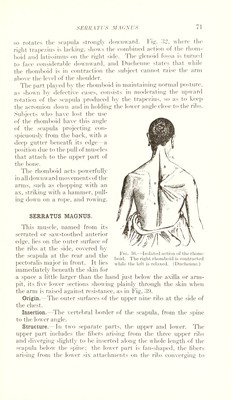
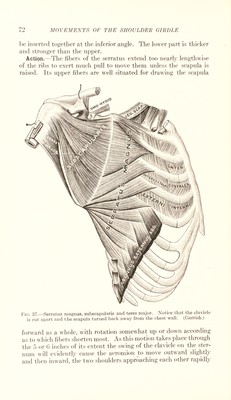
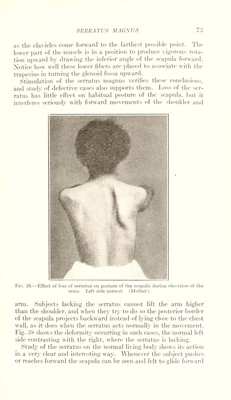
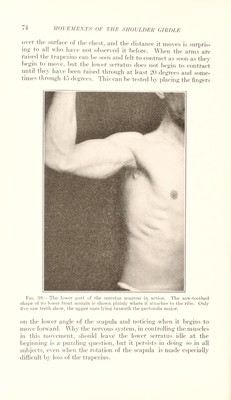
![as the clavicles come forward to the farthest ])ossiblc point. The lower part of the muscle is in a position to produce vigorous rota¬ tion upward by drawing the inferior angle of the scapula forward. Notice how well these lower fibers are placed to associate with the trapezius in turning the glenoid fossa upward. Stimulation of the serratus magnus verifies these conclusions, and study of defective cases also supports them. Loss of the ser¬ ratus has little effect on habitual posture of the scapula, but it interferes seriously with forward movements of the shoulder and Fig. 38.—Effect of loss of serratus on posture of the scapula during elevation of the arms. Left side normal. (Mollier.) arm. Subjects lacking the serratus cannot lift the arm higher than the shoulder, and when they try to do so the posterior border of the scapula projects backward instead of lying close to the chest wall, as it does when the serratus acts normally in the movement. Fig. 38 shows the deformity occurring in such cases, the normal left side contrasting with the right, where the serratus is lacking. Study of the serratus on the normal living body shows its action in a very clear and interesting way. Whenever the subject pushes or reaches forward the scapula can be seen and felt to glide forward](https://iiif.wellcomecollection.org/image/b29812124_0075.jp2/full/800%2C/0/default.jpg)
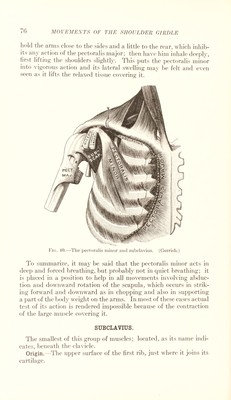
 No text description is available for this image
 No text description is available for this image
 No text description is available for this image