Understanding alcohol and alcoholism in Scotland / [Scottish Home and Health Dept].
- Great Britain. Scottish Home and Health Department. Health Education Unit
- Date:
- [between 1970 and 1979?]
Licence: Public Domain Mark
Credit: Understanding alcohol and alcoholism in Scotland / [Scottish Home and Health Dept]. Source: Wellcome Collection.
13/28 page 11
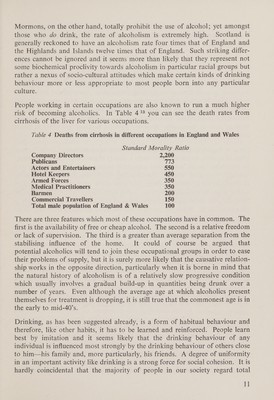
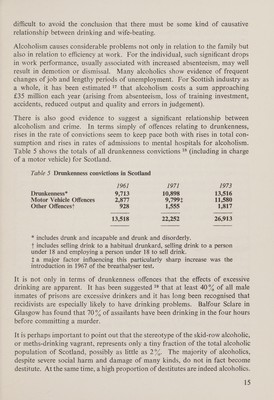
![those who do drink, the rate of alcoholism is extremely high. Scotland is generally reckoned to have an alcoholism rate four times that of England and the Highlands and Islands twelve times that of England.’ Such striking differ- ences cannot be ignored and it seems more than likely that they represent not some biochemical proclivity towards alcoholism in particular racial groups but rather a nexus of socio-cultural attitudes which make certain kinds of drinking behaviour more or less appropriate to most people born into any particular culture. People working in certain occupations are also known to run a much higher risk of becoming alcoholics. In Table 4% you can see the death rates from cirrhosis of the liver for various occupations. Table 4 Deaths from cirrhosis in different occupations in England and Wales Standard Morality Ratio Company Directors 2,200 Publicans 113 Actors and Entertainers 550 Hotel Keepers 450 Armed Forces 350 Medical Practitioners 350 Barmen 200 Commercial Travellers 150 Total male population of England & Wales 100 There are three features which most of these occupations have in common. The first is the availability of free or cheap alcohol. The second is a relative freedom or lack of supervision. The third is a greater than average separation from the stabilising influence of the home. It could of course be argued that potential alcoholics will tend to join these occupational groups in order to ease their problems of supply, but it is surely more likely that the causative relation- ship works in the opposite direction, particularly when it is borne in mind that the natural history of alcoholism is of a relatively slow progressive condition which usually involves a gradual build-up in quantities being drunk over a number of years. Even although the average age at which alcoholics present themselves for treatment is dropping, it is still true that the commonest age is in the early to mid-40’s. Drinking, as has been suggested already, is a form of habitual behaviour and therefore, like other habits, it has to be learned and reinforced. People learn best by imitation and it seems likely that the drinking behaviour of any individual is influenced most strongly by the drinking behaviour of others close to him—his family and, more particularly, his friends. A degree of uniformity in an important activity like drinking is a strong force for social cohesion. It 1s hardly coincidental that the majority of people in our society regard total 1]](https://iiif.wellcomecollection.org/image/b32175292_0013.jp2/full/800%2C/0/default.jpg)