Hereditary genius : an inquiry into its laws and consequences / by Francis Galton.
- Francis Galton
- Date:
- 1892
Licence: Public Domain Mark
Credit: Hereditary genius : an inquiry into its laws and consequences / by Francis Galton. Source: Wellcome Collection.
311/424 page 275
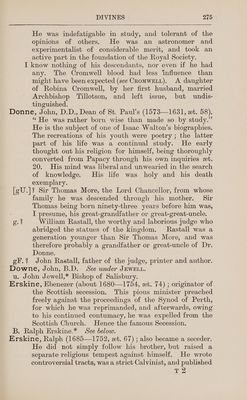
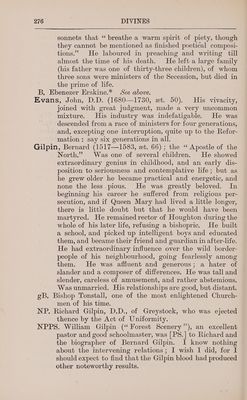
![He was indefatigable in study, and tolerant of the opinions of others. He was an astronomer and experimentalist of considerable merit, and took an active part in the foundation of the Royal Society. I know nothing of his descendants, nor even if he had any. ‘The Cromwell blood had less influence than might have been expected (see CROMWELL). A. daughter of Robina Cromwell, by her first husband, married Archbishop Tillotson, and left issue, but undis- tinguished. Donne, John, D.D., Dean of St. Paul’s (1573—1631, eet. 58). “He was rather born wise than made so by study.” He is the subject of one of Isaac Walton’s biographies. The recreations of his youth were poetry ; the latter part of his life was a continual study. He early thought out his religion for himself, being thoroughly converted from Papacy through his own inquiries et. 20. His mind was liberal and unwearied in the search of knowledge. His life was holy and his death exemplary. [gU.]? Sir Thomas More, the Lord Chancellor, from whose family he was descended through his mother. Sir Thomas being born ninety-three years before him was, T presume, his great-grandfather or great-great-uncle. 4 William Rastall, the worthy and laborious judge who abridged the statues of the kingdom. Rastall was a generation younger than Sir Thomas More, and was therefore probably a grandfather or great-uncle of Dr. Donne. gF.? John Rastall, father of the judge, printer and author. Downe, John, B.D. See under JEWELL. u. John Jewell,* Bishop of Salisbury. Erskine, Ebenezer (about 1680—1754, et. 74) ; originator of the Scottish secession. This pious minister preached freely against the proceedings of the Synod of Perth, for which he was reprimanded, and afterwards, owing to his continued contumacy, he was expelled from the Scottish Church. Hence the famous Secession. B. Ralph Erskine.* See below. Erskine, Ralph (1685—1752, et. 67) ; also became a seceder. He did not simply follow his brother, but raised a separate religious tempest against himself. He wrote controversial tracts, was a strict Calvinist, and published T 2 OJ)](https://iiif.wellcomecollection.org/image/b33954239_0311.jp2/full/800%2C/0/default.jpg)
 No text description is available for this image
 No text description is available for this image
 No text description is available for this image