Hereditary genius : an inquiry into its laws and consequences / by Francis Galton.
- Francis Galton
- Date:
- 1892
Licence: Public Domain Mark
Credit: Hereditary genius : an inquiry into its laws and consequences / by Francis Galton. Source: Wellcome Collection.
333/424 page 297
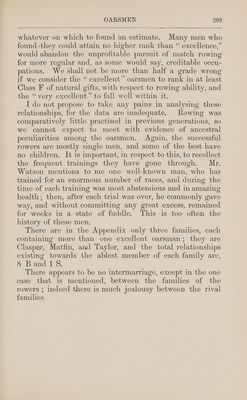
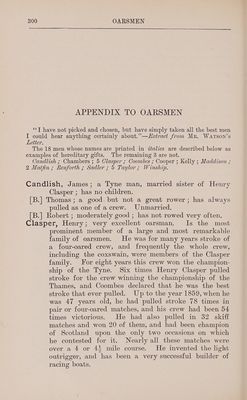
![into continual communication with one of the highest, I believe by far the highest, authority on boating matters, a person who had reported nearly every boating race’ to the newspapers for the last quarter of a century. The list in the Appendix to this chapter mcludes the names of nearly all the rowmg men of note who have figured upon the Tyne during the past six-and-twenty years. It also includes some of the rowers on the Thames, but the information about these is not so certain. The names are not picked and chosen, but the best men have been taken of whom any certain knowledge could be obtained. It is not easy to classify the rowers, especially as many of the men have rarely, if ever, pulled in skiff matches, but formed part of crews in pair-oared, four-oared, or six- oared matches. Their performances have, however, been carefully examined and criticised by Mr. Watson and his assessor, who have divided them into four classes. I have marked the names of the lowest with brackets. [| ], and have attached to them the phrase “moderately good.” These are men who have either disappointed expectations founded on early promise, or have not rowed often enough to show of what feats they are really capable. No complete failure is included. Few amateurs can cope with men of this class, notwithstanding the mediocrity of their abilities when judged by a professional standard. The next ascending grade is also distinguished by brackets [ ], but no qualifying expression is added to their names. They consist of the steady, reliable men who form good racing crews. The two superior grades contain the men whose names are printed without brackets—whom, in short, I treat as being “eminently gifted.’ In order to make a distinction between the two grades, I add to the names of the men who belong to the higher of them, the phrase “very excellent oarsmen.” It is not possible to do more than give a rough notion of the places into which these four grades would respec- tively fall in my table (p. 30) of natural gifts. I have](https://iiif.wellcomecollection.org/image/b33954239_0333.jp2/full/800%2C/0/default.jpg)
 No text description is available for this image
 No text description is available for this image
 No text description is available for this image