On a difficulty in isomorphism and in the received constitution of the oxygen-salts, in a letter to Professor Mitscherlich of the University of Berlin / from Thomas Clark.
- Clark, Thomas
- Date:
- [1836]
Licence: Public Domain Mark
Credit: On a difficulty in isomorphism and in the received constitution of the oxygen-salts, in a letter to Professor Mitscherlich of the University of Berlin / from Thomas Clark. Source: Wellcome Collection.
7/22 page 5
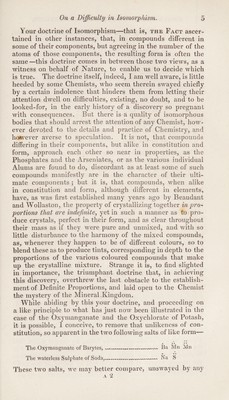
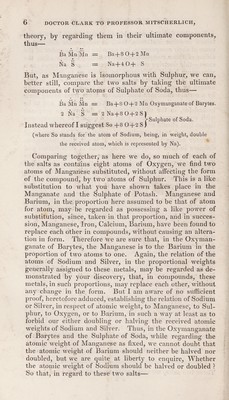
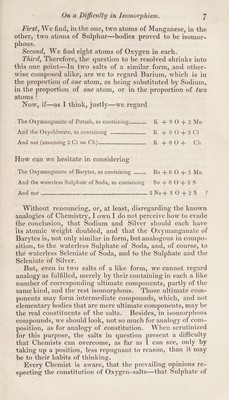
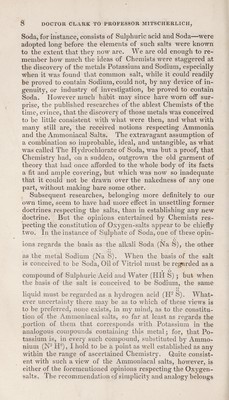
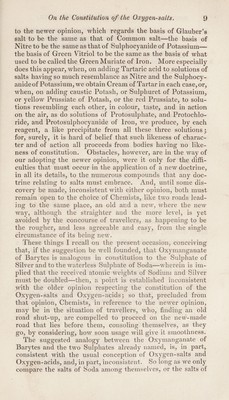
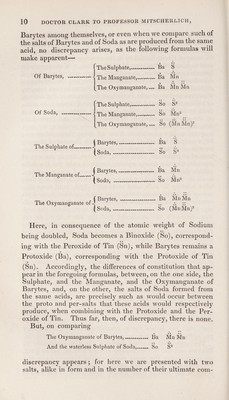
![Your doctrine of Isomorphism—that is, the Fact ascer¬ tained in other instances, that, in compounds different in some of their components, but agreeing in the number of the atoms of those components, the resulting form is often the same —this doctrine comes in between those two views, as a witness on behalf of Nature, to enable us to decide which is true. The doctrine itself, indeed, I am well aware, is little heeded by some Chemists, who seem therein swayed chiefly by a certain indolence that hinders them from letting their attention dwell on difficulties, existing, no doubt, and to be looked-for, in the early history of a discovery so pregnant with consequences. But there is a quality of isomorphous bodies that should arrest the attention of any Chemist, how¬ ever devoted to the details and practice of Chemistry, and ho*tvever averse to speculation. It is not, that compounds differing in their components, but alike in constitution and form, approach each other so near in properties, as the Phosphates and the Arseniates, or as the various individual Alums are found to do, discordant as at least some of such compounds manifestly are in the character of their ulti¬ mate components ; but it is, that compounds, when alike in constitution and form, although different in elements, have, as was first established many years ago by Beaudant and Wollaston, the property of crystallizing together in pro¬ portions that are indefinite^ yet in such a manner as to pro¬ duce crystals, perfect in their form, and as clear throughout their mass as if they were pure and unmixed, and with so little disturbance to the harmony of the mixed compounds, as, whenever they happen to be of different colours, so to blend these as to produce tints, corresponding in depth to the proportions of the various coloured compounds that make up the crystalline mixture. Strange it is, to find slighted in importance, the triumphant doctrine that, in achieving this discovery, overthrew the last obstacle to the establish¬ ment of Definite Proportions, and laid open to the Chemist the mystery of the Mineral .Kingdom. While abiding by this your doctrine, and proceeding on a like principle to what has just now been illustrated in the case of the Oxymanganate and the Oxychlorate of Potash, it is possible, I conceive, to remove that unlikeness of con¬ stitution, so apparent in the two following salts of like form—» • • • O V The Oxymanganate of Barytes, —--- Ba Mn ]\Jn « • • The waterless Sulphate of Soda,— -- Na S These two salts, w^e may better compare, unswayed by any A 2](https://iiif.wellcomecollection.org/image/b30559066_0007.jp2/full/800%2C/0/default.jpg)