On a difficulty in isomorphism and in the received constitution of the oxygen-salts, in a letter to Professor Mitscherlich of the University of Berlin / from Thomas Clark.
- Clark, Thomas
- Date:
- [1836]
Licence: Public Domain Mark
Credit: On a difficulty in isomorphism and in the received constitution of the oxygen-salts, in a letter to Professor Mitscherlich of the University of Berlin / from Thomas Clark. Source: Wellcome Collection.
9/22 page 7
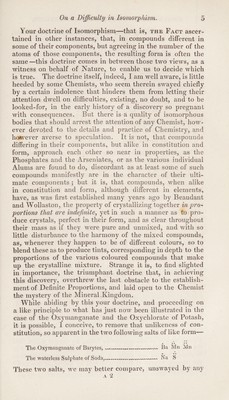
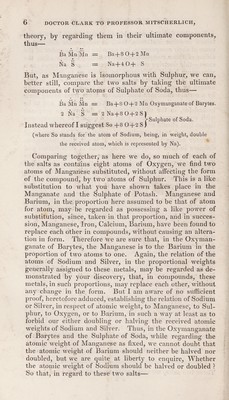
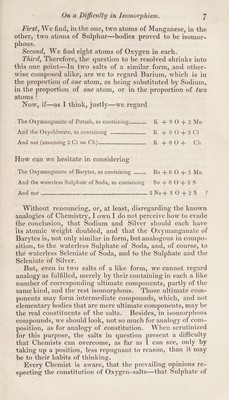
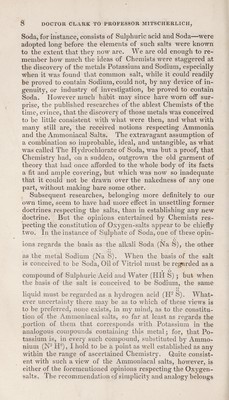
![First, We find, in the one^ two atoms of Manganese^ in the other, two atoms of Sulphur—bodies proved to be isomor- phous. Second, We find eight atoms of Oxygen in each. Third, Therefore, the question to be resolved shrinks into this one point—In two salts of a similar form, and other¬ wise composed alike, are we to regard Barium, which is in the proportion of one atom, as being substituted by Sodium, in the proportion of one atom, or in the proportion of two atoms ? Now, if—as I think, justly—we regard The Oxymanganate of Potash, as containing. And the Oxychlorate, as containing __ And not (assuming 2 Cl = Ch)- Iv 8 O “h 2 ]M n K 4- 8 O + 2 Cl K + 8 O + Ch How can we hesitate in considering The Oxymanganate of Barytes, as containing And the waterless Sulphate of Soda, as containing And not Ba + 8 O 4- 2 Mn So 4- 8 O 4- 2 S 2Na-f-80-|-2S ? Without renouncing, or, at least, disregarding the known analogies of Chemistry, I own I do not perceive how to evade the conclusion, that Sodium and Silver should each have its atomic weight doubled, and that the Oxymanganate of Barytes is, not only similar in form, but analogous in compo¬ sition, to the waterless Sulphate of Soda, and, of course, to the waterless Seleniate of Soda, and to the Sulphate and the Seleniate of Silver. But, even in two salts of a like form, we cannot regard analogy as fulfilled, merely by their containing in each a like number of corresponding ultimate components, partly of the same kind, and the rest isomorphous. Those ultimate com¬ ponents may form intermediate compounds, which, and not elementary bodies that are mere ultimate components, may be the real constituents of the salts. Besides, in isomorphous compounds, we should look, not so much for analogy of com¬ position, as for analogy of constitution. When scrutinized for this purpose, the salts in question present a difficulty that Chemists can overcome, as far as I can see, only by taking up a position, less repugnant to reason, than it may be to their habits of thinking. Every Chemist is aware, that the prevailing opinions re¬ specting the constitution of Oxygen-salts—that Sulphate of](https://iiif.wellcomecollection.org/image/b30559066_0009.jp2/full/800%2C/0/default.jpg)