Licence: Public Domain Mark
Credit: Hygiene of the painters' trade. Source: Wellcome Collection.
Provider: This material has been provided by the Augustus C. Long Health Sciences Library at Columbia University and Columbia University Libraries/Information Services, through the Medical Heritage Library. The original may be consulted at the the Augustus C. Long Health Sciences Library at Columbia University and Columbia University.
36/76 page 32
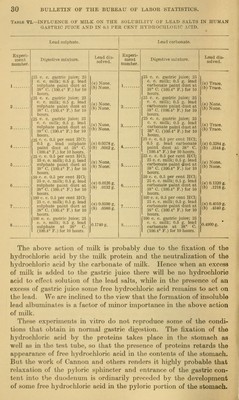
![2. Toxicity of lead xvhen/ed to dogs and cats. The lead carbonate is much more toxic than the lead sulphate, but both salts produce acute lead poisoning when given in quantities of 0.1 g. per kilo body weight per day. ij S. T]ie influence of milk. Wlien milk and gastric juice are mixed in the proportion of 1 to 1, the hj'drochloric acid of the gastric juice is so completely fixed by the milk protems or neutralized by the carbonates in the milk that the mixture has virtually no solvent action on the lead salts. But when the gastric juice is present in excess of the milk, the lead salts go into solution in proportion to the excess of gastric juice. When milk is taken mto the stomach there occurs, of course, a similar fixa- tion of the hydrochloric acid, and in addition the total quantity of gastric juice is diminished owing to the inhibitory action of the fat of the milk on the processes of secretion. 4. Three practical suggestions. On the basis of our work, we venture to offer these three practical suggestions: (a) The lead carbonate is so much more toxic than the lead sul- phate that lead workers as well as the State should aim at the elimi- nation of the use of the carbonate in all industries where this is possible, (&) Basic lead sulphate, or sublimed lead, is poisonous and none of the precautions usually advocated for the protection of workers in lead should be neglected by those handling lead sulphate. (c) In addition to taking other important prophylactic measures workers in lead salts should drink a glass of milk between meals (say at 10 a. m. and at 4 p. m.) in order to diminish the chances that the lead th^y have swallowed be dissolved by the free hydrochloric acid of the gastric juice, as in some persons there is considerable secre- tion of gastric juice in the empty stomach. METHODS OF USING AND REMOVING PAINT. The dangers involved in the use of paint depend upon the constitu- ents of the paint and on the way it is used. No paint need be dan- gerous if it is used with sufficient caution. If the thinner contains harmful volatile substances, these can be got rid of by proper ventila- tion of the room in which the work is being done. Men suffer from turpentine, petroleum, benzine, wood alcohol, or amyl acetate poison- ing because they are required to use these fluids in closed rooms. The defenders of flat-finish paints, which are leadless but contain dangerous volatile suljstances, insist that proper ventilation does](https://iiif.wellcomecollection.org/image/b21220037_0036.jp2/full/800%2C/0/default.jpg)




 No text description is available for this image
 No text description is available for this image
 No text description is available for this image