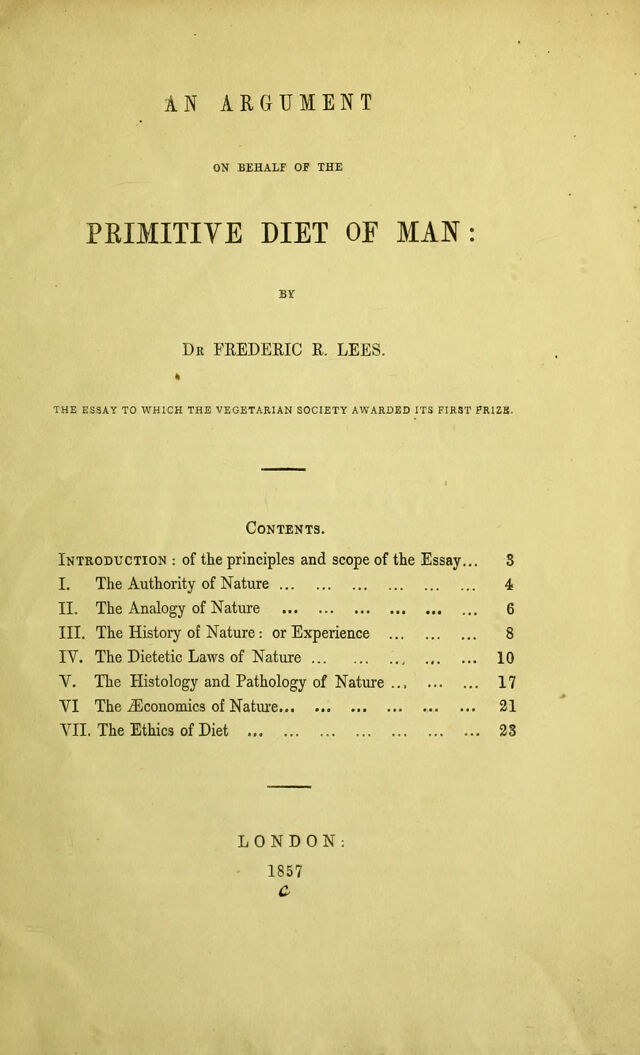
An argument on behalf of the primitive diet of man ... / by Frederic R. Lees.
- Frederic Richard Lees
- Date:
- 1857
Licence: Public Domain Mark
Credit: An argument on behalf of the primitive diet of man ... / by Frederic R. Lees. Source: Wellcome Collection.
Provider: This material has been provided by The University of Glasgow Library. The original may be consulted at The University of Glasgow Library.
25/36 page 23
![the productions of our soil to the wants of man as indicated by In- stinct and demonstrated by tbe analyses of Science, we could support an increasing population in comparative affluence, add prodigiously to tbe industrial wealth of tbe country at large, and give at once a new direction and a vast impetus to its agricultural improvement. § 33. Moleschott, who confounds a vegetal-diet with a diet of green-vegetables !—concedes, again and again, both tbe positive and negative basis of our plea. “ Tbe legumes,” says be, “ are superior to meat in the abundance of solid constituents which they contain; and while the amount of albuminous substances may surpass that in meat by one-half, tbe constit- uents of fat, and the salts, are also present in a greater abundance. ... Meat, bread, and leguminous seeds are serviceable in supporting the nutrition of the brain.... Blood, flesh, milk, etc., are abundantly formed by peas, beans, lentils ; and for this reason they are the comfort of poor-people, to whom flesh is so seldom and so sparingly allotted. ... Potatoes, combined with a certain proportion of white-of-egg [albumen], becomes as nourishing as milk or flesh. ... The growing-youth should be provided with cooling aliments, fruits and vegetables, water and acidulated beverages; and if then his mind is sufficiently occupied, and he takes abundant recreation in the open air, the tissue change will harmoniously promote the proportionate development of every part.” § 31. He even recognizes the evil of stimulants, both in general and particular. “ An excess of stimulants is more dangerous than a super- abundance of nutriment. ... The Roe, leading in the woods a free and active life, takes in a greater quantity of oxygen, which transforms the nitrogenized bases of the tissues into creatine.... The excitation of the activity of the heart, observed after a copious meal of venison, is due not only to the abundance of albuminous matter in the venison, but also probably to the proportionately large quantity of creatine. ... The sexual impulse is more excited.” * VII. The 'Ethics of Eiet. § 35. It is time we ceased to consider this question from the low ground of chemical-equivalents and exchanges: or from the stand- point of the Prize-show or Cattle-market. It is not how much fat and flesh a given fodder will enable us to lay upon the carcase of a beast, but how shall we best subserve, by our regimen, the great moral and social There is probably but one or two things which can be referred to as a Model food; such as the Grape in a temperate region, and Mother’s milk. Accepting this last as a standard, as regards its solids, then a near approach to a perfect diet would include the following parts and proportions :— Albumen 10 ; Pat 10; Sugar 20 ; Salts 0.6 of a part. * Theory of Nutrition, § 58. § 42. § 97. § 89. Moleschoti's admissions. Perfect diet.](https://iiif.wellcomecollection.org/image/b24921440_0025.jp2/full/800%2C/0/default.jpg)


 No text description is available for this image
 No text description is available for this image
 No text description is available for this image