On the agency of water in volcanic eruptions : with some observations on the thickness of the Earth's crust from a geological point of view, and on the primary cause of volcanic action / by Joseph Prestwich.
- Joseph Prestwich
- Date:
- 1886
Licence: Public Domain Mark
Credit: On the agency of water in volcanic eruptions : with some observations on the thickness of the Earth's crust from a geological point of view, and on the primary cause of volcanic action / by Joseph Prestwich. Source: Wellcome Collection.
Provider: This material has been provided by The Royal College of Surgeons of England. The original may be consulted at The Royal College of Surgeons of England.
41/64 (page 153)
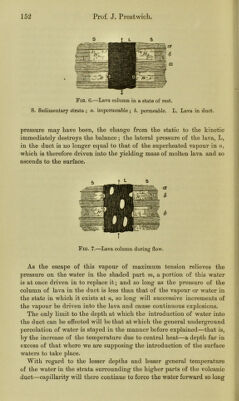
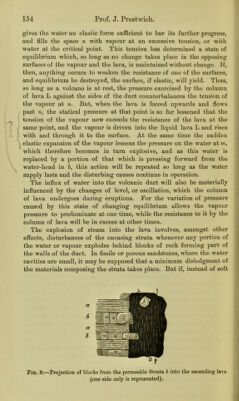
![as tlie underground water stands at a sufficiently high level. Mallet was of opinion* that capillary infiltration goes on in all porous rocks at enormous depths, and that the deeply seated walls of the volcanic ducts leading to the crater, if of such materials, may be red hot, and yet continue to pass water from every pore (like the walls of a well in chalk), which is flashed off into steam, and, unable to return by the way the water came down, escapes through the duct and crater. For my own part, I do not think this can happen during a state of undisturbed statical pressure, but that it follows on any disturbance. That capillarity exercises a very important influence on the under- ground percolation of water is undoubted. To a certain point it has been proved experimentally by M. Daubree,f who found that water placed on a disk of fine-grained (Triassic) sandstone,]; fastened over a vessel filled with steam under pressure of nearly two atmospheres, infiltrated into the underlying vessel against that pressure. He further noticed that in consequence of the heat the action was more rapid than it otherwise would have been; and—making the experiment inversely —he observed that vapour placed under a pressure of several atmo- spheres in the lower vessel, did not transude through the disk left dry on the upper surface. As before pointed out, however, capillarity is adversely affected by a rise of temperature, and is comparatively inoperative at high temperatures. Under these circumstances, it is conceivable that water may readily be carried down through the upper cooler strata to the proximity of the volcanic duct. But no amount of available vapour tension could force it back through the same depth of strata against both friction and capillarity. At the same time when the elastic tension of the vapour of the water reaches the point either of critical temperature, or such higher temperature that it exceeds the hydrostatic pressure, the further progress or descent of the water will be prevented. The influx of water to the volcanic duct is to a certain point effected under the same conditions as those which effect its general descent to depths through the earth’s crust. But at this point, whatever it may be, other causes come into operation, which, while the descent of water to the volcanic foci beneath the solid crust remains an impossibility, renders its introduction into the volcanic ducts, even at considerable depths, possible. In any case, when an equilibrium is established between the vapour tension and the hydrostatic pressure, no change will take place unless that condition of equilibrium be disturbed. Such a cause exists in the case of a volcanic duct. In fig. 7 the surface-waters pass in the usual manner through the strata b to some point m, where the heat from the lava L in the duct * Palmieri’s “ Eruption of Vesuvius in 1872.” Mallet’s Introduction, p. 52. t “ Ofeologie Experimental,” 1879, p. 236. X The absorbent power of this rock = 6’9 per cent, by weight.](https://iiif.wellcomecollection.org/image/b22446151_0043.jp2/full/800%2C/0/default.jpg)