On the agency of water in volcanic eruptions : with some observations on the thickness of the Earth's crust from a geological point of view, and on the primary cause of volcanic action / by Joseph Prestwich.
- Joseph Prestwich
- Date:
- 1886
Licence: Public Domain Mark
Credit: On the agency of water in volcanic eruptions : with some observations on the thickness of the Earth's crust from a geological point of view, and on the primary cause of volcanic action / by Joseph Prestwich. Source: Wellcome Collection.
Provider: This material has been provided by The Royal College of Surgeons of England. The original may be consulted at The Royal College of Surgeons of England.
5/64
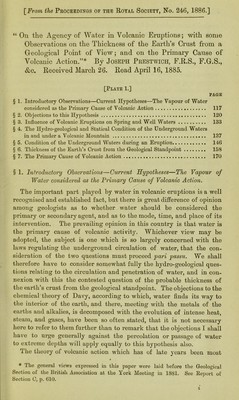
![[From the Proceedings of the Royal Society, No. 246, 1886.] “ On the Agency of Water in Volcanic Eruptions; -with some Observations on the Thickness of the Earth’s Crust from a Geological Point of View; and on the Primary Cause of Volcanic Action.”* By Joseph Prestwich, F.R.S., F.G.S., &c. Received March 26. Read April 16, 1885. [Plate 1.] PAGE § 1. Introductory Observations—Current Hypotheses—The Yapour of Water considered as the Primary Cause of Volcanic Action 117 § 2. Objections to this Hypothesis 120 § 3. Influence of Volcanic Eruptions on Spring and Well Waters 133 § 4. The Hydro-geological and Statical Condition of the Underground Waters in and under a Volcanic Mountain 137 § 5. Condition of the Underground Waters during an Eruption 146 § 6. Thickness of the Earth’s Crust from the G-eological Standpoint 158 § 7. The Primary Cause of Volcanic Action 170 § 1. Introductory Observations—Current Hypotheses—The Vapour of Water considered as the Primary Cause of Volcanic Action. The important part played by water in volcanic eruptions is a well recognised and established fact, but there is great difference of opinion among geologists as to whether water should be considered the primary or secondary agent, and as to the mode, time, and place of its intervention. The prevailing opinion in this country is that water is the primary cause of volcanic activity. Whichever view may be adopted, the subject is one which is so largely concerned with the laws regulating the underground circulation of water, that the con- sideration of the two questions must proceed pari passu. We shall therefore have to consider somewhat fully the hydro-geological ques- tions relating to the circulation and penetration of water, and in con- nexion with this the contested question of the probable thickness of the earth’s crust from the geological standpoint. The objections to the chemical theory of Davy, according to which, water finds its way to the interior of the earth, and there, meeting with the metals of the earths and alkalies, is decomposed with the evolution of intense heat, steam, and gases, have been so often stated, that it is not necessary here to refer to them further than to remark that the objections I shall have to urge generally against the percolation or passage of water to extreme depths will apply equally to this hypothesis also. The theory of volcanic action which has of late years been most 4 * The general views expressed in this paper were laid before the Geological Section of the British Association at the York Meeting in 1881. See Report of Section C, p. 610.](https://iiif.wellcomecollection.org/image/b22446151_0007.jp2/full/800%2C/0/default.jpg)