Progress report on the Uganda sleeping sickness camps from December, 1906, to November 30th, 1908 / by A. D. P. Hodges. With an appendix on breeding grounds of glossina palpalis, by A. D. Fraser and Claude H. Marshall.
- Hodges, A. D. P.
- Date:
- 1909
Licence: In copyright
Credit: Progress report on the Uganda sleeping sickness camps from December, 1906, to November 30th, 1908 / by A. D. P. Hodges. With an appendix on breeding grounds of glossina palpalis, by A. D. Fraser and Claude H. Marshall. Source: Wellcome Collection.
Provider: This material has been provided by London School of Hygiene & Tropical Medicine Library & Archives Service. The original may be consulted at London School of Hygiene & Tropical Medicine Library & Archives Service.
36/48 page 34
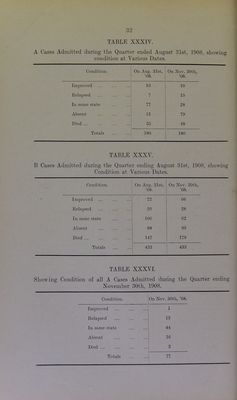
![4. After a 6 months course of atoxyl by method No. 1 a course of injections of soluble mercury salts repeated every 5 days. At present it cannot be said that any one of the above methods has any special advantage from a curative point of view. Toxic effects occur more frequently where the larger initial doses of atoxyl are used. Salivation is more apt to result during the use of method No. 1 than the other methods. (See Appendix on the occurrence of eye-symptoms.) Tables XXXVIII and XLII give a comparison of the results obtained from various methods of treatment, while Tables XXXIX, XL and XLI compare the results from treatment with atoxyl and with atoxyl and mercury. It will be seen from Table XLI that the percentages of improvement under these two methods are about the same, while the death rate is considerably higher in the case of atoxyl. This]higher death rate is accounted for by the fact that in Busoga camp com- paratively few cases (110 only) were treated with mercury, which it was found was tolerated badly by the emaciated patients received during the famine. From Table XXXVIII we see that 1,834 cases were treated with atoxyl only and 1,422 with atoxyl and mercury. Of these cases 984 and 110 respectively belong to Busoga, so that more than half of the cases treated by atoxyl only were treated at Busoga camp, while 1,312 out of 1,422 cases which received atoxyl and mercury were treated at the other three camps, where conditions were favourable. By taking the Busoga figures separately we can make comparison of results as follows :— At all camps, improved under f atoxyl only, 14-5 % 1 \ with mercury, 15 • 0 % J died / 42 -1 %. 1 21-9 %. At Busoga camps, „ / atoxyl only, 12-7 % 1 \ with mercury, 8 • 1 % J died f 50-4 %. 1 76-3 %. Other camps, „ 99 J atoxyl only, 16-4 % 1 \ with mercury, 15 • 6 % J died 125-6 %. 116-4 %. From the above comparison it is seen that, eliminating the Busoga cases, the improvement rate is not greatly altered, though that for atoxyl becomes slightly the higher, while the death rate for atoxyl, lowered from 42 -1 % to 25-6 %, remains higher than that for atoxyl and mercury. The percentage results from the two methods of treatment are thus very similar to those for cases admitted during the first year. TABLE XXXVIII. Showing condition on November 30th, 1908, of all Cases Admitted during the Second Year under Various Methods of Treatment. Condition. Atoxyl. Atoxyland Mercury. Other Methods. Untreated. Totals. Improved 267 214 97 578 Relapsed 68 102 29 !99 Continued in same state 235 206 229 670 Absent 491 600 58 18 1.167 Died 773 300 173 36 1.282 Totals 1,834 1,422 586* 54 3,896 * See Table XLII.](https://iiif.wellcomecollection.org/image/b24916171_0038.jp2/full/800%2C/0/default.jpg)




 No text description is available for this image
 No text description is available for this image
 No text description is available for this image