Volume 2
First-[second] report of the Royal Sanitary Commission.
- Great Britain. Royal Sanitary Commission
- Date:
- 1869-1874
Licence: Public Domain Mark
Credit: First-[second] report of the Royal Sanitary Commission. Source: Wellcome Collection.
Provider: This material has been provided by London School of Hygiene & Tropical Medicine Library & Archives Service. The original may be consulted at London School of Hygiene & Tropical Medicine Library & Archives Service.
139/418 (page 131)
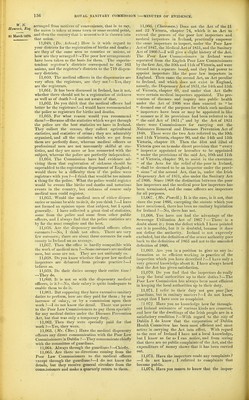
![10.949. You could conceive that any liooks in which nuisances ought to be entei'ed might be entirely blank in the worst cases ? ■— I can quite conceive that. 10.950. In speaking of a committee of guardians or of any other local authority, should you recommend that the powers of that committee be complete powers delegated to them by the authoiity, or that the com- mittee should in each case refer back to the authority for confirmation ?—My present impression is tbat the committee ought to have power up to a certain amount to act for themselves without confirmation ; but that whenever the expenditure exceeded a certain sum they should then have to go to tlie board of guardians who have constituted them, for their sanction. 10.951. Would you be of this opinion that in any work of considerable importance and permanence there should be a reference to the entire body, but that in small matters, such as the removal of any given nuisance, the committee should have full power to act ? —I think that some distinction of that sort should be drawn, and no other mode suggests itself to me except the probable expense. There may be frequently occasions upon which it would be very convenient and right that the committee should be authorized to act promptly in the removal of a nuisance acting immediately prejudicially upon health ; and supposing it was not a very great matter the committee should have power to act independently of the board of guardians, and simply to report to them ; but in all cases involving any considerable expenditure the board of guardians should be parties to the same upon the report of the committee. 10.952. In a case within my knowledge the sanitary committee of the authority recommended a disin- fecting apparatus, but the authority to which it was necessary to refer the matter absolutely repudiated such a notion ; should you think it better to leave it to time to bring about a better state of opinion in the authority, or would you wish the committee to have power to act at once in a case of that kind ?—I must again say that I think the expense would be something of a test. I am not sure whether in such a case as that I would not invest the Secretary of State with the power, upon investigation, of overruling the veto of the local authority. 10.953. How would you say that the day of a relieving officer was occupied ?—relieving officer ought always to have a certain fixed time for going to particular parishes. His first point when he goes to parish A. is to pay the poor according to the orders given to him by the board of guardians at their previous meeting, those poor Avho attend at the pay-table. His duty then would be in the few cases probably in which the parties could not attend, either by themselves or by some person for them, to visit the houses of such poor persons, and to give them the necessary relief. He ought then to visit, from time to time, I will not sav every week, but to visit those who may, from chronic sickness, be regularly in receipt of relief, and having done that, he should be ready to receive any new appli- cations, and in the case of those applications presenting peculiar circumstances, he should visit the persons from whom the applications came. 10.954. Is it found easy, or is it a matter of diffi- culty to keep the relieving officer well up to his work ?—The relieving officers are very numerous, and therefore one may well suppose that they very much differ in the mode in which they perform their duties. There are among them, as far as 1 know, a consider- able number who perform their duties very regularly and promptly. ] 0,955. Do you think that there would be much prac- tical difficulty arising from this consideration, that at present the relieving officer has the duty that you have described, and you know pretty well what he ought to do in the course of a certain number of hours, but if he were inclined to be indolent he might be idlino- away his time, and might tell you, were he also nui- sance inspector, that he was looking after nuisances, and there might be a difficulty in having any check upon him ?—I think that might to a considerable RigU Hon. extent be met hy requiring, as is done in some unions Earlnf Devon. with good effect, that the relieving officer should keep a diary, and that that diary be presented to the 31 March 1870. board of guardians at each weekly meeting. 10.956. Do you think it a matter of much import- ance that the relieving officer should have the wliole of his time devoted to the relief of the poor, and that he should thereby be gathering a very wide expe- rience ?—It should be devoted to the relief of the poor, or to subjects of a strictly cognate charactt r. 10.957. Do you think that there would be much loss of efficiency by the inspector having to watch over nuisances of the very wide class, wiiich are coniia-e- hended under that term, and all other matters which are embraced in sanitary administration ?—Unless inconvenience I'esulted from the absorption of their time, and their withdrawal from the purposes of relief. I do not-, see that that consequence would follow. 10.958. Which would be the best course, for Par- liament to say in a statute that the relieving officer shall also be the inspector of nuisances, or to leave it free to each authority to arrange that matter as they thought best ?—^I would leave it free to each authority. 10.959. In your answer to a question, Avhen you mentioned the guardians as the local authority, did you understand that they were to be the authority in the country only, or in the whole of England ?—The honorable gentleman did me the favour of correcting my misapprehension. I was under the impression that the guardians throughout the whole of Englai^d were contemplated. 10.960. Is your Lordship's answer in favour of the _ guardians as the authority in any degree modified by the opinion that raral guardians are less efficient than urban guardians, and that therefore the best of the guardians would cease to be the authorities if they were not the authority in the ui'ban districts ?—I think, as I said just now, that there would be certain instances at first in which the duties would not be adequately performed by the rural guardians ; but still rural guardians would gradually be trained on to the due performance of those duties if the inspectors were sufficiently numerous and vigilant. 10.961. (Earl of Romney.) You said just now that you trusted that those rural boards of guardians would be well inspected, and that by degrees they would be educated for their work; v/hen you sjjoke of inspectors in that sense, what class of inspector did yoit mean ?—I was referring to the opportunities which rural boards of guardians would have of re- ceiving visits from the poor law inspectors, which might be increased so far as was necessary, and the advantage of the personal conversations which they would have with them, and the hints given by those inspectors, and afterwards given them by the Poor Law Board, which would enable them to carry out whatever was wished. 10.962. When you said, in answer to Mr. Powell, that you considered that it was absolutely necessary that the inspectors should go to the spot in order to inspect nuisances, of what class of inspectors were you then speaking ?—I do not know that I spoke quite as strongly as the noble lord says that I thought it absolutely necessary. I said that there would be many cases in which a personal inspection would be necessary, and certain cases in which they might act upon report, but I should consider it very desh-able, ordinarily speaking, when an inspector went in to a particular union, if his time should admit of it, tliHt he should not miss any opportunity of visiting any part with regard to which complaints had been made by any party that nuisances of a serious character existed. 10.963. But would not the ordinary inspection from day to day be carried on by the inspector of nuisance? whom we talked about as being the relieving officer —It ought to be so. 1(>,964. So that there are two distinct officers called inspectors in our conversation ?—Yes, one is the in- spector of poor laws, who by the proposal has added to his duties as inspector of poor laws, the duty also](https://iiif.wellcomecollection.org/image/b21366081_0002_0139.jp2/full/800%2C/0/default.jpg)