Volume 2
First-[second] report of the Royal Sanitary Commission.
- Great Britain. Royal Sanitary Commission
- Date:
- 1869-1874
Licence: Public Domain Mark
Credit: First-[second] report of the Royal Sanitary Commission. Source: Wellcome Collection.
Provider: This material has been provided by London School of Hygiene & Tropical Medicine Library & Archives Service. The original may be consulted at London School of Hygiene & Tropical Medicine Library & Archives Service.
143/418 (page 135)
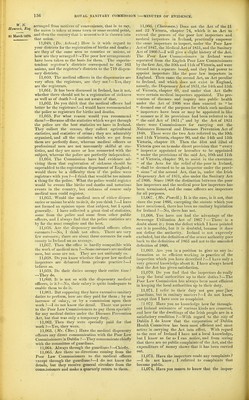
![the guardians generally have discharged their duties under those Acts ?—I have always heard the Act spoken of as giving satisfaction. I might say, as my attention has been called to it, that there is some information which the Commission would like to obtain which is not yet officially collected, but if the Commission would wish to have it collected, I will have it collected for them. I have been able to submit statistics of what the guardians have done under those three Acts, and you might like to know Avhat the town authorities have done. In the way the local taxation has been collected hitherto, (it was collected to compare with the English statistics,) that exact information Avas not collected, but if the Com- mission express a wish upon the subject I will submit it to the Under Secretary for Ireland to have that information collected for you. 11.029. {Chnir))ian.) What was the provision of the Act of 1851, which created dispensary districts ? —It is the 14th and 15th of Victoria, chapter 68, the Dispensary Act; and the main provision of that Act was appointing a medical commissioner attached to the poor law, and placing the whole of the medical arrangements under the Poor Law Commissioners. The guardians of each union were to divide the union into dispensary districts. 11.030. How many dispensary districts are there in one union ?—They run from two to ten districts in a union. There are 163 unions in Ireland and 719 dispensary districts. 11.031. What is the governing body of the dis- pensary district ?—The governing body of a dispensary district is a committee, and by the 7th section of the Dispensary Act, 1851, it is provided that The guardians of the union shall elect, if necessary, a sufficient number of ratepayers resident in each district, and liable to pay poor rates in respect of property therein of the net annual value of 30/. at the least, who, together with the ex-officio and elected guardians of the poor resident, or being the owners or occupiers of property therein, shall be a committee for the management of the dispensary of such district. 11.032. What are the duties of the committee of management?—The dispensary coniuiitlee appoints a medical officer, with salary dependent upon the guardians, and every member of such dispensary committee, and every relieving officer and warden acting for an electoral division included in such dispensary district shall have power to afford medical relief by the issue of a ticket for medicine and advice, or a ticket in such form as the said Commissioners shall prescribe.(14 & 15 Vict. c. 68. sec. 9.) 11.033. Have they any other duties except those connected with the relief of the poor ?—They are employed by the guardians in special cases for the Diseases Prevention Act, and they have charge of that Act while it is in operation, but they have no other duties besides that I am aware of. 11.034. There is a clause in the Sanitary Act of ] 866, in the part relating to Ireland, and I find this provision that The ^jrovisions of the Dispensary Act, 1851, with respect to the duties and appointment of medical inspectors shall be incorporated with this Act, and the prevention of disease and inquiry into public health under this Act shall be deemed one of the purposes to which such medical inspectors have been or may be appointed in like manner as if its provisions had been referred to in the said Act of 1851, instead of the provisions of the said Nuisance Removal and Diseases Prevention Act of 1848. Can you explain that provision?-— In Ireland we have under the Dispensary Act special medical poor law inspectors. I think the Act of 1868 (31 & 32 Vict. c. 74) has consolidated the duties of these officers with the general inspectors. I recollect that a section was put in to require the Poor Law Commissioners to make their medical inspectors the officers for carrying out the diseases preveution provisions, and also those inquiries into public health that the Commissioners might be directed to make from time to time. 11,034a. Under the Medical Charities Act, the Poor Law Commissioners appointed medical in- spectors whose duty it was to inspect the medical arrangements of each uniign ?—Yes, under the Medical Charities, or as I have called it the Dispensary Act. 11.035. That arrangement, has since been altered, has it not ?—Yes. 11.036. (Lord E. Montagu.) You have spoken of the board of guardians as the body to administer the Sanitary Act. Would you tell us, as to the constitu - tion of the board of guardians, whether it is not a fact that the number of elected guardians are equal to the number of ex ajficio guardians ?—Wherever there are a sufficient number of resident ex officio guardians qualified, the ex ojfficio guardians may be equal to the number elected, and in all the large unions they are equal to them. 11.037. Is not the number of elected guardians restricted to the number of ex ojfficio guardians ?—No, it is the other way, the number of ex ojfficio guardians cannot exceed the number of elected guardians, and the number of elected guardians is fixed. In all unions where there are a number of resident gentlemen the magistrates exceed the guardians. There is only then a certain number of magistrates on the board, and in unions where there are fewer magistrates residing, sometimes the elected guardians are more numerous than the magistrates. 11.038. How is the number of elected guardians determined?—By order of the Poor Law Commis- sioners. There was a revision in Ireland, after the famine, of all the electoral divisions, and the number of guardians vvere fixed by order of the Poor Law Commissioners. 11.039. Each electoral division elects so many?— Yes, generally one ; but the town divisions elect two or three. 11.040. As a general rule, the number of ex officio guardians and the number of elected guardians are equal, are they not ?—^In a large number of unions tliey are equal, and the exception is in unions where there are a very small number of justices qualified by residence or by having 50^. a year out of the union if non-resident. 11,011. Can you tell me whether the ex officio guardians attend regularly ?—I believe so. The chair- man, the vice-chairman, and the deputy vice-chairman are generally ca; officio guardians, and they attend very regularly, and they have a great deal of influence in carrying on the business^ because a man who is constantly the chairman has great weight with the guardians. 11.042. Can you tell me whether the petty sessional districts in Ireland are the same as unions or electoral divisions or dispensary districts ?—No, they are fixed by a different authority altogether, and have no neces- sary connection with the unions at all. 11.043. Do they happen to coincide in area ?—No, they are not fixed with reference to the sau;e theory at all, and practically they do not coincide. 11.044. Can you tell me whether the un'ons are contermiuous with the counties ?—No, the unions are not conterminous with the counties. 11.045. Do thay happen to coincide ?—No. 11.046. (^Chairman.) Do they overlap the bounda- ries ?—Yes, constantly. For instance, a great number of the most important of our Irish towns arc situated on rivers, on the borders of the counties. The to-wn is taken as the centre of the union, and the unioii takes in the district round it. 11.047. {Lord R. Montagu.) Do any petty sessions districts ever go outside the borders of the county ? —^Yes, constantly. They are fixed with regard to the same theory, but they are much more numerous than the unions. There are about 608 petty sessions dis- tricts and 163 unions. 11.048. Then the areas of petty sessions districts have nothing to say to either the areas of unions or the areas of counties ?—Not at all., They, are both R 4 W. N. Hancock, Esg. 31 March 1870.](https://iiif.wellcomecollection.org/image/b21366081_0002_0143.jp2/full/800%2C/0/default.jpg)